Weekend Edition Saturday, April 7, 2007 · Political satirist Christopher Buckley's novel Boomsday features a young blogger who suggests the U.S. government might offer baby boomers tax incentives to kill themselves before retirement age.
Boomsday
by Christopher Buckley
Outraged over the mounting Social Security debt, Cassandra Devine, a charismatic 29-year-old blogger and member of Generation Whatever, incites massive cultural warfare when she politely suggests that Baby Boomers be given government incentives to kill themselves by age 75. Her modest proposal catches fire with millions of citizens, chief among them "an ambitious senator seeking the presidency." With the help of Washington's greatest spin doctor, the blogger and the politician try to ride the issue of euthanasia for Boomers (called "transitioning") all the way to the White House, over the objections of the Religious Right, and of course, the Baby Boomers, who are deeply offended by demonstrations on the golf courses of their retirement resorts.
Sunday, April 08, 2007

Saturday, April 07, 2007
Rickie Lee Jones' Divine Departure
All Things Considered, April 7, 2007 · (npr.org)
In Rickie Lee Jones' heaven, Janis Joplin works at the corner bar and folks ride around in Elvis' Cadillac.
It's a paradise that only the "Dutchess of Coolsville" could imagine, and one she's brought to vivid life in her new album, The Sermon on Exposition Boulevard.
The Grammy winner's first original album in four years was inspired by the words of Jesus – some with a bit more poetic license than others.
Jones isn't religious in the traditional sense. Growing up, she occasionally attended Catholic mass, but was never baptized. She tells host Debbie Elliott that in America, Jesus is "kind of owned by the religious right."
Jones says her album is an attempt to spark a conversation about Jesus' teachings, and make him more accessible to people who don't go to church.
She credits longtime friend Lee Cantelon with providing the genesis of her new album. In 1997 Cantelon published The Words, a compilation of Jesus' words taken from the four Gospels of the New Testament.
He turned his book into a spoken-word project, and in 2005 he asked Jones to read a passage. Rather than do a reading, Jones improvised and sang "Nobody Knows My Name," which eventually became the first track on the album.
The Sermon on Exposition Boulevard doesn't stray entirely from Jones' bohemian roots. The lyrics, which tell stories of the divine and the worldly, still contain her beat-poet style.
In Rickie Lee Jones' heaven, Janis Joplin works at the corner bar and folks ride around in Elvis' Cadillac.
It's a paradise that only the "Dutchess of Coolsville" could imagine, and one she's brought to vivid life in her new album, The Sermon on Exposition Boulevard.
The Grammy winner's first original album in four years was inspired by the words of Jesus – some with a bit more poetic license than others.
Jones isn't religious in the traditional sense. Growing up, she occasionally attended Catholic mass, but was never baptized. She tells host Debbie Elliott that in America, Jesus is "kind of owned by the religious right."
Jones says her album is an attempt to spark a conversation about Jesus' teachings, and make him more accessible to people who don't go to church.
She credits longtime friend Lee Cantelon with providing the genesis of her new album. In 1997 Cantelon published The Words, a compilation of Jesus' words taken from the four Gospels of the New Testament.
He turned his book into a spoken-word project, and in 2005 he asked Jones to read a passage. Rather than do a reading, Jones improvised and sang "Nobody Knows My Name," which eventually became the first track on the album.
The Sermon on Exposition Boulevard doesn't stray entirely from Jones' bohemian roots. The lyrics, which tell stories of the divine and the worldly, still contain her beat-poet style.
Sunday, April 01, 2007
AFI Dallas
DISPATCH FROM TEXAS Newbie AFI Dallas Fest Kicks the Door In
Wednesday March 28 4:58 PM ET
by Michael Jones
Four hours north from the Whole Earthy shops that sell "Keep Austin Weird" merchandise, an upscale Dallas thread shop displays, for twice the price, their own T-shirt: "Keep Dallas Pretentious." And with no apologies, the AFI Dallas International Film Festival began as founder Liener Temerlin, an unabashed "old ad man," stated that Dallas "may now hold the world record in size, films, venues, and sponsors for an inaugural film festival." Though the birth of yet another new film festival shouldn't make much of a ripple, Temerlin and company might have started a new franchising trend. Licensing the AFI brand for a festival was probably akin to attaching stars to a script -- it brought in a laundry list of big blue chip sponsors.
Artistic Director Michael Cain, previously of the Deep Ellum Film Festival, and his team built a program heavy on Texas-born talent, AFI alum (David Lynch's "Inland Empire"), and suggestions from AFI Los Angeles' Christian Gaines ("Drama/Mex" and "Screamers"). Opening the fest with Dallas-native Steve Sawalich's "Music Within" was the safe choice. Starring Ron Livingston as a deaf Vietnam vet fighting for the disabled Americans' rights, the film rides the middle of the road well, though breaks no ground.
Fellow Dallasite Amy Talkington's light, cheery romp, "Night of the White Pants," turned a circus mirror onto the furs and boots in the audience. Shot locally, it stars Tom Wilkerson as an ex-millionaire Dallas dealmaker battling lawyers, greedy ex-wives, spoiled children, and his own spoiled past. Wilkerson threw himself into the North Texas drawl with both feet and fists, but within all his character's good ole boy ego, Wilkerson's hound-dog eyes keep his performance refreshingly grounded. The audience ate it up, as they'll do with Talkington's next target: Dallas debutantes.
Narrative competition films included a few imports from Sundance 2007 including Steve Berra's "The Good Life" and Martin Hynes' "The Go-Getter," a lost-in-America story that, despite genuine moments of young love between the illuminant Zooey Deschanel and Lou Taylor Pucci, manages to lose its way mid-story. Crowds inside the Majestic Theater in Dallas attending the inaugural festival. For more photos, check out the festival's Flickr photo site.
Among the docs, Joel P. Engardio and Tom Shepard's "Knocking," put the audience inside the homes of Jehovah's Witnesses, for a change. In its best moments the journalists follow a Witness family into a "bloodless" liver transplant. Witnesses don't believe in using another's blood, or even a stored bag of their own, during surgery. Most even carry a card instructing caregivers "no blood." When a father decides to donate a portion of his liver to his ailing son, the family searches far and wide for a hospital that will do a transfusion-less transplant. They find it at USC who, in exchange, want to use the surgery to test new procedures that will reduce the need for donor blood. Using that as a jumping off point, the filmmakers continue to outline Jehovah Witness history, including their imprisonment in Nazi concentration camps and their victories in litigating for free speech in the US and abroad.
Other noteworthy docs included University of Texas professor Andrew Garrison's "Third Ward, TX," named after a Houston neighborhood where a group of African-American artists took over a block of abandoned homes just before their leveling. After creating unique artist spaces, parks, and much-needed low-income housing, the group then faced the result of their success: gentrification and myopic real estate development. In the aptly titled "A Lawyer Walks Into a Bar," filmmaker Eric Chaikin follows six people striving to become among the measly 39% that pass the California bar exam, including one unlucky subject who's failed it 41 times.
While potshots at Dallas pretension are easy, it's as useless as shooting barrel fish. Dallas doesn't care what you think. They like their art and they like to pay for it. The Dallas Contemporary, The Nasher, and neighboring Modern Art Museum of Fort Worth are all well funded and arguably premiere destinations for modern art in the Midwest. And while Variety reported the fest's pricetag at $4 million, much of that money seemed spent on the filmmakers: from the first class airfare to the swank W Hotel rooms, complete with a 3-bottle gift of fine wine in a fancy Target-designed box (just one item among the avalanche of swag). And when Dallasites show up to see David Lynch present his three-hour, interior-view of Laura Dern's head, they do it in their Neiman Marcus best, they stay through the whole thing, and they applaud when it's over. There is pretension here, and there is also class.
[EDITOR'S NOTE: The inaugural AFI Dallas International Film Festival continues through Sunday, April 1 in Texas.]
Wednesday March 28 4:58 PM ET
by Michael Jones
Four hours north from the Whole Earthy shops that sell "Keep Austin Weird" merchandise, an upscale Dallas thread shop displays, for twice the price, their own T-shirt: "Keep Dallas Pretentious." And with no apologies, the AFI Dallas International Film Festival began as founder Liener Temerlin, an unabashed "old ad man," stated that Dallas "may now hold the world record in size, films, venues, and sponsors for an inaugural film festival." Though the birth of yet another new film festival shouldn't make much of a ripple, Temerlin and company might have started a new franchising trend. Licensing the AFI brand for a festival was probably akin to attaching stars to a script -- it brought in a laundry list of big blue chip sponsors.
Artistic Director Michael Cain, previously of the Deep Ellum Film Festival, and his team built a program heavy on Texas-born talent, AFI alum (David Lynch's "Inland Empire"), and suggestions from AFI Los Angeles' Christian Gaines ("Drama/Mex" and "Screamers"). Opening the fest with Dallas-native Steve Sawalich's "Music Within" was the safe choice. Starring Ron Livingston as a deaf Vietnam vet fighting for the disabled Americans' rights, the film rides the middle of the road well, though breaks no ground.
Fellow Dallasite Amy Talkington's light, cheery romp, "Night of the White Pants," turned a circus mirror onto the furs and boots in the audience. Shot locally, it stars Tom Wilkerson as an ex-millionaire Dallas dealmaker battling lawyers, greedy ex-wives, spoiled children, and his own spoiled past. Wilkerson threw himself into the North Texas drawl with both feet and fists, but within all his character's good ole boy ego, Wilkerson's hound-dog eyes keep his performance refreshingly grounded. The audience ate it up, as they'll do with Talkington's next target: Dallas debutantes.
Narrative competition films included a few imports from Sundance 2007 including Steve Berra's "The Good Life" and Martin Hynes' "The Go-Getter," a lost-in-America story that, despite genuine moments of young love between the illuminant Zooey Deschanel and Lou Taylor Pucci, manages to lose its way mid-story. Crowds inside the Majestic Theater in Dallas attending the inaugural festival. For more photos, check out the festival's Flickr photo site.
Among the docs, Joel P. Engardio and Tom Shepard's "Knocking," put the audience inside the homes of Jehovah's Witnesses, for a change. In its best moments the journalists follow a Witness family into a "bloodless" liver transplant. Witnesses don't believe in using another's blood, or even a stored bag of their own, during surgery. Most even carry a card instructing caregivers "no blood." When a father decides to donate a portion of his liver to his ailing son, the family searches far and wide for a hospital that will do a transfusion-less transplant. They find it at USC who, in exchange, want to use the surgery to test new procedures that will reduce the need for donor blood. Using that as a jumping off point, the filmmakers continue to outline Jehovah Witness history, including their imprisonment in Nazi concentration camps and their victories in litigating for free speech in the US and abroad.
Other noteworthy docs included University of Texas professor Andrew Garrison's "Third Ward, TX," named after a Houston neighborhood where a group of African-American artists took over a block of abandoned homes just before their leveling. After creating unique artist spaces, parks, and much-needed low-income housing, the group then faced the result of their success: gentrification and myopic real estate development. In the aptly titled "A Lawyer Walks Into a Bar," filmmaker Eric Chaikin follows six people striving to become among the measly 39% that pass the California bar exam, including one unlucky subject who's failed it 41 times.
While potshots at Dallas pretension are easy, it's as useless as shooting barrel fish. Dallas doesn't care what you think. They like their art and they like to pay for it. The Dallas Contemporary, The Nasher, and neighboring Modern Art Museum of Fort Worth are all well funded and arguably premiere destinations for modern art in the Midwest. And while Variety reported the fest's pricetag at $4 million, much of that money seemed spent on the filmmakers: from the first class airfare to the swank W Hotel rooms, complete with a 3-bottle gift of fine wine in a fancy Target-designed box (just one item among the avalanche of swag). And when Dallasites show up to see David Lynch present his three-hour, interior-view of Laura Dern's head, they do it in their Neiman Marcus best, they stay through the whole thing, and they applaud when it's over. There is pretension here, and there is also class.
[EDITOR'S NOTE: The inaugural AFI Dallas International Film Festival continues through Sunday, April 1 in Texas.]
Wednesday, March 28, 2007
Abundance: A Novel of Marie Antoinette
Sena Jeter Naslund made flesh and blood a boldly original fictional character called "Ahab's wife". Now, she combines rigorous scholarship and blazing imagination to illuminate the life of Marie Antoinette, one of the most courageous—and misunderstood—queens in history.
"Like everyone, I am born naked."
This opening line of Naslund's compelling new novel, a very human Marie Antoinette invites readers to live her story as she herself experiences it. Marie Antoinette was a child of fourteen when her mother, the Empress of Austria, arranged for her to become the wife of the fifteen-year-old Dauphin, the future King of France. The young queen embraces her new family and the French people, and she is embraced in return. She shows her new husband nothing but love and encouragement, though he fails to give her a child and an heir to the throne.
Deeply disappointed and isolated, the queen allows herself to remain ignorant of the country's growing economic and political crises, and the people turn against her. Poor harvests, bitter winters, war debts, and poverty precipitate rebellion and revenge known as "the Terror."
Once again, Sena Jeter Naslund has shed new light on an important moment of historical change. Exquisitely detailed, beautifully written, heartbreaking and powerful, Abundance is a novel that is impossible to put down.
Library Journal
Lush with description and deep with historical detail, Naslund's (Ahab's Wife) latest novel weaves the epic of Marie Antoinette in all her misunderstood glory. Beginning with the ceremony that transforms the Hapsburg archduchess into the dauphine, the story captures a young girl's becoming the product of her circumstances. From her struggles to be diplomatic with her new family and subjects, to her marriage left unconsummated for years, Marie recalls her life in intelligent and mature observations. And when the first tremors of the French Revolution are felt, we see her struggle with her wishes to keep her children and husband safe. Immersing us in the life of the French court at its most vulnerable and decadent time, Naslund's marvelous work is more detailed and has more depth than Carolly Erickson's The Hidden Diary of Marie Antoinette. Highly recommended for all public libraries.
"Like everyone, I am born naked."
This opening line of Naslund's compelling new novel, a very human Marie Antoinette invites readers to live her story as she herself experiences it. Marie Antoinette was a child of fourteen when her mother, the Empress of Austria, arranged for her to become the wife of the fifteen-year-old Dauphin, the future King of France. The young queen embraces her new family and the French people, and she is embraced in return. She shows her new husband nothing but love and encouragement, though he fails to give her a child and an heir to the throne.
Deeply disappointed and isolated, the queen allows herself to remain ignorant of the country's growing economic and political crises, and the people turn against her. Poor harvests, bitter winters, war debts, and poverty precipitate rebellion and revenge known as "the Terror."
Once again, Sena Jeter Naslund has shed new light on an important moment of historical change. Exquisitely detailed, beautifully written, heartbreaking and powerful, Abundance is a novel that is impossible to put down.
Library Journal
Lush with description and deep with historical detail, Naslund's (Ahab's Wife) latest novel weaves the epic of Marie Antoinette in all her misunderstood glory. Beginning with the ceremony that transforms the Hapsburg archduchess into the dauphine, the story captures a young girl's becoming the product of her circumstances. From her struggles to be diplomatic with her new family and subjects, to her marriage left unconsummated for years, Marie recalls her life in intelligent and mature observations. And when the first tremors of the French Revolution are felt, we see her struggle with her wishes to keep her children and husband safe. Immersing us in the life of the French court at its most vulnerable and decadent time, Naslund's marvelous work is more detailed and has more depth than Carolly Erickson's The Hidden Diary of Marie Antoinette. Highly recommended for all public libraries.
A Little Bit of Night Music
Learn about the Sarabande
In music, the sarabande (It., sarabanda) is a slow dance in triple metre with the distinctive feature that beats 2 and 3 of the measure are often tied, giving a distinctive rhythm of crotchet and minim in alternation. The minims are said to have corresponded with dragging steps in the dance.
The sarabande is first mentioned in Central America: in 1539, a dance called a zarabanda is mentioned in a poem written in Panama by Fernando Guzmán Mexía.[1] Apparently the dance became popular in the Spanish colonies before moving back across the Atlantic to Spain. While it was banned in Spain in 1583 for its obscenity, it was frequently cited in literature of the period (for instance in works by Cervantes and Lope de Vega).
Later, it became a traditional movement of the suite during the baroque period. The baroque sarabande is commonly a slow triple rather than the much faster Spanish original, consistent with the courtly European interpretations of many Latin dances. The sarabande form was revived in the 20th Century by composers such as Debussy, Satie and, in a different style, Vaughan Williams (in Job) and Benjamin Britten (in the Simple Symphony)
Perhaps the most famous sarabande is the anonymous La folie espagnole whose melody appears in pieces by dozens of composers from the time of Monteverdi and Corelli through the present day.
This was discussed in the book Abundance: see previous post.
In music, the sarabande (It., sarabanda) is a slow dance in triple metre with the distinctive feature that beats 2 and 3 of the measure are often tied, giving a distinctive rhythm of crotchet and minim in alternation. The minims are said to have corresponded with dragging steps in the dance.
The sarabande is first mentioned in Central America: in 1539, a dance called a zarabanda is mentioned in a poem written in Panama by Fernando Guzmán Mexía.[1] Apparently the dance became popular in the Spanish colonies before moving back across the Atlantic to Spain. While it was banned in Spain in 1583 for its obscenity, it was frequently cited in literature of the period (for instance in works by Cervantes and Lope de Vega).
Later, it became a traditional movement of the suite during the baroque period. The baroque sarabande is commonly a slow triple rather than the much faster Spanish original, consistent with the courtly European interpretations of many Latin dances. The sarabande form was revived in the 20th Century by composers such as Debussy, Satie and, in a different style, Vaughan Williams (in Job) and Benjamin Britten (in the Simple Symphony)
Perhaps the most famous sarabande is the anonymous La folie espagnole whose melody appears in pieces by dozens of composers from the time of Monteverdi and Corelli through the present day.
This was discussed in the book Abundance: see previous post.
Thursday, December 28, 2006
Quotes by Gerald R. Ford
Gerald R. Ford Quotes
“He [Gerald R. Ford, Sr.] and Mother had three rules: tell the truth, work hard, and come to dinner on time—and woe unto any of us who violated those rules.”From President Ford's memoir, A Time to Heal1979
“I am not a saint, and I am sure I have done things I might have done better or differently, or not at all. I have also left undone things that I should have done. But I believe and hope that I have been honest with myself and with others, that I have been faithful to my friends and fair to my opponents, and that I have tried my very best to make this great Government work for the good of all Americans.”Statement before the Senate Committee on Rules and Administration [Vice Presidential Confirmation Hearings]November 1, 1973
“I am a Ford, not a Lincoln.”Remarks after being sworn in as Vice President of the United StatesDecember 6, 1973“I promise my fellow citizens only this: To uphold the Constitution, to do what is right as God gives me to see the right, and…to do the very best that I can for America.”Remarks after being sworn in as Vice President of the United StatesDecember 6, 1973
"I have not sought this enormous responsibility, but I will not shirk it . . . I believe that truth is the glue that holds government together, not only our Government, but civilization itself. That bond, though strained, is unbroken at home and abroad. In all my public and private acts as your President, I expect to follow my instincts of openness and candor with full confidence that honesty is always the best policy in the end. My fellow Americans, our long national nightmare is over. Our Constitution works; our great Republic is a Government of laws and not of men. Here the people rule.”Remarks upon being sworn in as President of the United StatesAugust 9, 1974
“A government big enough to give you everything you want is a government big enough to take from you everything you have.”Address to a Joint Session of CongressAugust 12, 1974
“This Congress, unless it has changed, I am confident, will be my working partner as well as my most constructive critic. I am not asking for conformity. I am dedicated to the two-party system, and you know which party I belong to. I do not want a honeymoon with you. I want a good marriage.” Address to a Joint Session of CongressAugust 12, 1974
“As we are a nation under God, so I am sworn to uphold our laws with the help of God. And I have sought such guidance and searched my own conscience with special diligence to determine the right thing for me to do with respect to my predecessor in this place, Richard Nixon, and his loyal wife and family. Theirs is an American tragedy in which we all have played a part. It could go on and on and on, or someone must write the end to it. I have concluded that only I can do that, and if I can, I must.”Remarks upon granting a pardon to former President Richard NixonSeptember 8, 1974
“Desertion in time of war is a major, serious offense; failure to respond to the country’s call for duty is also a serious offense. Reconciliation among our people does not require that these acts be condoned. Yet, reconciliation calls for an act of mercy to bind the Nation’s wounds and to heal the scars of divisiveness.”Remarks upon announcing a clemency program for Vietnam era draft evaders September 16, 1974
“We are bound together by the most powerful of all ties, our fervent love for freedom and independence, which knows no homeland but the human heart.”Address before the Conference on Security and Cooperation in EuropeAugust 1, 1975
“History will judge this Conference not by what we say here today, but by what we do tomorrow - not by the promises we make, but by the promises we keep.”Address before the Conference on Security and Cooperation in EuropeAugust 1, 1975
“As we continue our American adventure…all our heroes and heroines of war and peace send us this single, urgent message: though prosperity is a good thing, though compassionate charity is a good thing, though institutional reform is a good thing, a nation survives only so long as the spirit of sacrifice and self-discipline is strong within its people. Independence has to be defended as well as declared; freedom is always worth fighting for; and liberty ultimately belongs only to those willing to suffer for it.”Bicentennial Remarks at Valley Forge, PennsylvaniaJuly 4, 1976
“The world is ever conscious of what Americans are doing, for better or for worse, because the United States today remains that most successful realization of humanity’s universal hope. The world may or may not follow, but we lead because our whole history says we must. Liberty is for all men and women as a matter of equal and unalienable right. The establishment of justice and peace abroad will in large measure depend upon the peace and justice we create here in our own country, for we still show the way.”Bicentennial Remarks at Independence Hall Philadelphia, PennsylvaniaJuly 4, 1976 “Remember that none of us are more than caretakers of this great country. Remember that the more freedom you give to others, the more you will have for yourself. Remember that without law there can be no liberty. And remember, as well, the rich treasures you brought from whence you came, and let us share your pride in them.”Remarks during Naturalization Ceremonies at Monticello, VirginiaJuly 5, 1976
“To me, the Presidency and the Vice-Presidency were not prizes to be won, but a duty to be done.”Remarks upon accepting the Republican Presidential Nomination, Kansas City, MissouriAugust 19, 1976
I am a loyal Wolverine. When they lose in football, basketball, or anything I still get darn disappointed."Remarks from a phone interview to the Ann Arbor News before the University of Michigan retired his football numberOctober 8, 1994.
"Some people equate civility with weakness and compromise with surrender. I strongly disagree. I come by my political pragmatism the hard way, for my generation paid a very heavy price in resistance to the century we had of some extremists -- to the dictators, the utopians, the social engineers who are forever condemning the human race for being all too human."Remarks upon receiving the Congressional Gold MedalOctober 27, 1999.
“I have always believed that most people are mostly good, most of the time. I have never mistaken moderation for weakness, nor civility for surrender. As far as I'm concerned, there are no enemies in politics--just temporary opponents who might vote with you on the next Roll Call.”Remarks upon receiving the John F. Kennedy Profile in Courage AwardMay 21, 2001
“. . . The ultimate test of leadership is not the polls you take, but the risks you take. In the short run, some risks prove overwhelming. Political courage can be self-defeating. But the greatest defeat of all would be to live without courage, for that would hardly be living at all.”Remarks upon receiving the John F. Kennedy Profile in Courage AwardMay 21, 2001
“He [Gerald R. Ford, Sr.] and Mother had three rules: tell the truth, work hard, and come to dinner on time—and woe unto any of us who violated those rules.”From President Ford's memoir, A Time to Heal1979
“I am not a saint, and I am sure I have done things I might have done better or differently, or not at all. I have also left undone things that I should have done. But I believe and hope that I have been honest with myself and with others, that I have been faithful to my friends and fair to my opponents, and that I have tried my very best to make this great Government work for the good of all Americans.”Statement before the Senate Committee on Rules and Administration [Vice Presidential Confirmation Hearings]November 1, 1973
“I am a Ford, not a Lincoln.”Remarks after being sworn in as Vice President of the United StatesDecember 6, 1973“I promise my fellow citizens only this: To uphold the Constitution, to do what is right as God gives me to see the right, and…to do the very best that I can for America.”Remarks after being sworn in as Vice President of the United StatesDecember 6, 1973
"I have not sought this enormous responsibility, but I will not shirk it . . . I believe that truth is the glue that holds government together, not only our Government, but civilization itself. That bond, though strained, is unbroken at home and abroad. In all my public and private acts as your President, I expect to follow my instincts of openness and candor with full confidence that honesty is always the best policy in the end. My fellow Americans, our long national nightmare is over. Our Constitution works; our great Republic is a Government of laws and not of men. Here the people rule.”Remarks upon being sworn in as President of the United StatesAugust 9, 1974
“A government big enough to give you everything you want is a government big enough to take from you everything you have.”Address to a Joint Session of CongressAugust 12, 1974
“This Congress, unless it has changed, I am confident, will be my working partner as well as my most constructive critic. I am not asking for conformity. I am dedicated to the two-party system, and you know which party I belong to. I do not want a honeymoon with you. I want a good marriage.” Address to a Joint Session of CongressAugust 12, 1974
“As we are a nation under God, so I am sworn to uphold our laws with the help of God. And I have sought such guidance and searched my own conscience with special diligence to determine the right thing for me to do with respect to my predecessor in this place, Richard Nixon, and his loyal wife and family. Theirs is an American tragedy in which we all have played a part. It could go on and on and on, or someone must write the end to it. I have concluded that only I can do that, and if I can, I must.”Remarks upon granting a pardon to former President Richard NixonSeptember 8, 1974
“Desertion in time of war is a major, serious offense; failure to respond to the country’s call for duty is also a serious offense. Reconciliation among our people does not require that these acts be condoned. Yet, reconciliation calls for an act of mercy to bind the Nation’s wounds and to heal the scars of divisiveness.”Remarks upon announcing a clemency program for Vietnam era draft evaders September 16, 1974
“We are bound together by the most powerful of all ties, our fervent love for freedom and independence, which knows no homeland but the human heart.”Address before the Conference on Security and Cooperation in EuropeAugust 1, 1975
“History will judge this Conference not by what we say here today, but by what we do tomorrow - not by the promises we make, but by the promises we keep.”Address before the Conference on Security and Cooperation in EuropeAugust 1, 1975
“As we continue our American adventure…all our heroes and heroines of war and peace send us this single, urgent message: though prosperity is a good thing, though compassionate charity is a good thing, though institutional reform is a good thing, a nation survives only so long as the spirit of sacrifice and self-discipline is strong within its people. Independence has to be defended as well as declared; freedom is always worth fighting for; and liberty ultimately belongs only to those willing to suffer for it.”Bicentennial Remarks at Valley Forge, PennsylvaniaJuly 4, 1976
“The world is ever conscious of what Americans are doing, for better or for worse, because the United States today remains that most successful realization of humanity’s universal hope. The world may or may not follow, but we lead because our whole history says we must. Liberty is for all men and women as a matter of equal and unalienable right. The establishment of justice and peace abroad will in large measure depend upon the peace and justice we create here in our own country, for we still show the way.”Bicentennial Remarks at Independence Hall Philadelphia, PennsylvaniaJuly 4, 1976 “Remember that none of us are more than caretakers of this great country. Remember that the more freedom you give to others, the more you will have for yourself. Remember that without law there can be no liberty. And remember, as well, the rich treasures you brought from whence you came, and let us share your pride in them.”Remarks during Naturalization Ceremonies at Monticello, VirginiaJuly 5, 1976
“To me, the Presidency and the Vice-Presidency were not prizes to be won, but a duty to be done.”Remarks upon accepting the Republican Presidential Nomination, Kansas City, MissouriAugust 19, 1976
I am a loyal Wolverine. When they lose in football, basketball, or anything I still get darn disappointed."Remarks from a phone interview to the Ann Arbor News before the University of Michigan retired his football numberOctober 8, 1994.
"Some people equate civility with weakness and compromise with surrender. I strongly disagree. I come by my political pragmatism the hard way, for my generation paid a very heavy price in resistance to the century we had of some extremists -- to the dictators, the utopians, the social engineers who are forever condemning the human race for being all too human."Remarks upon receiving the Congressional Gold MedalOctober 27, 1999.
“I have always believed that most people are mostly good, most of the time. I have never mistaken moderation for weakness, nor civility for surrender. As far as I'm concerned, there are no enemies in politics--just temporary opponents who might vote with you on the next Roll Call.”Remarks upon receiving the John F. Kennedy Profile in Courage AwardMay 21, 2001
“. . . The ultimate test of leadership is not the polls you take, but the risks you take. In the short run, some risks prove overwhelming. Political courage can be self-defeating. But the greatest defeat of all would be to live without courage, for that would hardly be living at all.”Remarks upon receiving the John F. Kennedy Profile in Courage AwardMay 21, 2001
Remembering Gerald
Mrs. Betty Ford issued the following statement from her home in Rancho Mirage, California:
"My family joins me in sharing the difficult news that Gerald R. Ford, our beloved husband, father, grandfather, and great grandfather, has passed away at 93 years of age. His was a life filled with love of God, his family, and his country."
Funeral details for the 38th President of the United States will be provided by the Joint Force Headquarters-National Capitol Region and the U.S. Army Military District of Washington Public Affairs Office to both the public and the media as they become available. Any media requests are to be directed to the U.S. Army Military District Public Affairs Office at (202) 685-4644. For information and press releases, visit the Gerald R. Ford Memorial site at www.GeraldFordMemorial.comPresident Ford's family requests that contributions be made to the Gerald R. Ford Foundation Memorial Fund. This request includes donations in lieu of flowers. Information about the memorial contributions and the way you can send a message of condolence to the Ford family can be found at www.GeraldFordMemorial.comThe Gerald R. Ford Presidential Library and Museum are offering extended hours for those who wish to express their sympathy to the Ford family, including signing a condolence book.In Ann Arbor, the Library lobby will be open 9:00 a.m.-7:30 p.m. on Thurs. and Fri (Dec. 28-29) and Tues. - Weds. (Jan. 2-3). The lobby will be open 1:00 p.m. - 7:30 p.m. on Saturday, Sunday and New Year's Day (Dec. 30 - Jan. 1). The Library's research room will be closed during this period and will reopen on Thursday, January 4, 2007. In Grand Rapids, the Museum lobby will be open 24 hours/day until further notice beginning December 27, 2006. The Museum's other areas, including all exhibit galleries and the gift store, will be closed until 9:00 a.m. Saturday, January 6, 2007.
http://www.fordlibrarymuseum.gov/default.asp
News, Special Events & Featured Pages
Media Photo Kits, Re: President Ford's Life
Timeline of President Ford's Life and Career
Gerald R. Ford Quotes
Library and Museum events calendar
Museum opens Slavery on Trial: The Long Road to Freedom, December 8, 2006 [requires Windows Media Player]
Slavery on Trial: The Long Road to Freedom, online exhibit
Art of Diplomacy Exhibit at Ford Library
Website re-design information
Located at the University of Michigan in Ann Arbor, The Ford Library collects, preserves, and makes accessible a rich variety of archival materials on U.S. domestic issues, foreign relations, and political affairs during the Cold War era. The Library offers exhibits, special events, education partnerships, and reference services. Located in Grand Rapids, Michigan, The Ford Museum's permanent exhibits allow visitors to actually participate in history while reviewing the lives of President and Mrs. Ford. A succession of feature exhibits draw upon the holdings of the entire Presidential Libraries System, Smithsonian Institution, National Archives, and others.
"My family joins me in sharing the difficult news that Gerald R. Ford, our beloved husband, father, grandfather, and great grandfather, has passed away at 93 years of age. His was a life filled with love of God, his family, and his country."
Funeral details for the 38th President of the United States will be provided by the Joint Force Headquarters-National Capitol Region and the U.S. Army Military District of Washington Public Affairs Office to both the public and the media as they become available. Any media requests are to be directed to the U.S. Army Military District Public Affairs Office at (202) 685-4644. For information and press releases, visit the Gerald R. Ford Memorial site at www.GeraldFordMemorial.comPresident Ford's family requests that contributions be made to the Gerald R. Ford Foundation Memorial Fund. This request includes donations in lieu of flowers. Information about the memorial contributions and the way you can send a message of condolence to the Ford family can be found at www.GeraldFordMemorial.comThe Gerald R. Ford Presidential Library and Museum are offering extended hours for those who wish to express their sympathy to the Ford family, including signing a condolence book.In Ann Arbor, the Library lobby will be open 9:00 a.m.-7:30 p.m. on Thurs. and Fri (Dec. 28-29) and Tues. - Weds. (Jan. 2-3). The lobby will be open 1:00 p.m. - 7:30 p.m. on Saturday, Sunday and New Year's Day (Dec. 30 - Jan. 1). The Library's research room will be closed during this period and will reopen on Thursday, January 4, 2007. In Grand Rapids, the Museum lobby will be open 24 hours/day until further notice beginning December 27, 2006. The Museum's other areas, including all exhibit galleries and the gift store, will be closed until 9:00 a.m. Saturday, January 6, 2007.
http://www.fordlibrarymuseum.gov/default.asp
News, Special Events & Featured Pages
Media Photo Kits, Re: President Ford's Life
Timeline of President Ford's Life and Career
Gerald R. Ford Quotes
Library and Museum events calendar
Museum opens Slavery on Trial: The Long Road to Freedom, December 8, 2006 [requires Windows Media Player]
Slavery on Trial: The Long Road to Freedom, online exhibit
Art of Diplomacy Exhibit at Ford Library
Website re-design information
Located at the University of Michigan in Ann Arbor, The Ford Library collects, preserves, and makes accessible a rich variety of archival materials on U.S. domestic issues, foreign relations, and political affairs during the Cold War era. The Library offers exhibits, special events, education partnerships, and reference services. Located in Grand Rapids, Michigan, The Ford Museum's permanent exhibits allow visitors to actually participate in history while reviewing the lives of President and Mrs. Ford. A succession of feature exhibits draw upon the holdings of the entire Presidential Libraries System, Smithsonian Institution, National Archives, and others.
Gerald R. Ford's Recent Activities
Gerald R. Ford's Recent Activities
President Ford turned 93 years old in July 2006, and resides in Rancho Mirage, California. He participates in many of the activities of both the Gerald R. Ford Foundation and his Presidential Library and Museum. President Ford serves on the Board of Directors of several U.S. corporations and contributes time and effort to many charities. He especially supports the Boy Scouts of America and the Betty Ford Center for addiction recovery. President Ford has continued to speak out on, and has remained involved in, important political causes. He served as honorary Co-Chair (with former President Carter) of the National Commission on Federal Election Reform in 2001. He has also contributed several opinion pieces to The New York Times and Washington Post on topics such as:
"The Path Back to Dignity," re: President Bill Clinton (1998)
"A Time to Heal Our Nation," re: Clinton Impeachment (written jointly with President Jimmy Carter) (1998)
"Inclusive America, Under Attack," re: Affirmative Action (1999)
"The Wisdom of Choosing Dick Cheney," re: George W. Bush running mate selection (2000)
"Curing, Not Cloning," (2002)
"The Friendship, and Toughness, of Hugh Sidey," (2005)
President Ford is committed to continuing to contribute to the improvement of the quality of life for all Americans, and his commitment has been recognized by many organizations. In August, 1999 President Ford received the Medal of Freedom. This honor, the nation's highest civilian award, was presented by President Bill Clinton in recognition of President Ford's role in guiding the nation through the turbulent times of Watergate, the resignation of President Nixon and the end of the Vietnam War. In October, 1999 President and Mrs. Ford were awarded the Congressional Gold Medal for "dedicated public service and outstanding humanitarian contributions." In 2000 the University of Michigan honored him by naming after him the Gerald R. Ford School of Public Policy. In May, 2001 he received the Profiles in Courage Award from the Kennedy Foundation for placing the country's interest over his own political future in pardoning Richard Nixon. Although President Ford has cut back on his travel and public appearances in recent years, he did attend President Ronald Reagan's funeral at the National Cathedral in June 2004, and in November 2004 he participated in the groundbreaking ceremony for the University of Michigan School of Public Policy's new building.
President Ford turned 93 years old in July 2006, and resides in Rancho Mirage, California. He participates in many of the activities of both the Gerald R. Ford Foundation and his Presidential Library and Museum. President Ford serves on the Board of Directors of several U.S. corporations and contributes time and effort to many charities. He especially supports the Boy Scouts of America and the Betty Ford Center for addiction recovery. President Ford has continued to speak out on, and has remained involved in, important political causes. He served as honorary Co-Chair (with former President Carter) of the National Commission on Federal Election Reform in 2001. He has also contributed several opinion pieces to The New York Times and Washington Post on topics such as:
"The Path Back to Dignity," re: President Bill Clinton (1998)
"A Time to Heal Our Nation," re: Clinton Impeachment (written jointly with President Jimmy Carter) (1998)
"Inclusive America, Under Attack," re: Affirmative Action (1999)
"The Wisdom of Choosing Dick Cheney," re: George W. Bush running mate selection (2000)
"Curing, Not Cloning," (2002)
"The Friendship, and Toughness, of Hugh Sidey," (2005)
President Ford is committed to continuing to contribute to the improvement of the quality of life for all Americans, and his commitment has been recognized by many organizations. In August, 1999 President Ford received the Medal of Freedom. This honor, the nation's highest civilian award, was presented by President Bill Clinton in recognition of President Ford's role in guiding the nation through the turbulent times of Watergate, the resignation of President Nixon and the end of the Vietnam War. In October, 1999 President and Mrs. Ford were awarded the Congressional Gold Medal for "dedicated public service and outstanding humanitarian contributions." In 2000 the University of Michigan honored him by naming after him the Gerald R. Ford School of Public Policy. In May, 2001 he received the Profiles in Courage Award from the Kennedy Foundation for placing the country's interest over his own political future in pardoning Richard Nixon. Although President Ford has cut back on his travel and public appearances in recent years, he did attend President Ronald Reagan's funeral at the National Cathedral in June 2004, and in November 2004 he participated in the groundbreaking ceremony for the University of Michigan School of Public Policy's new building.
Gerald R. Ford Biography
Gerald R. Ford Biography
http://www.fordlibrarymuseum.gov/grf/fordbiop.asp
Gerald Rudolph Ford, the 38th President of the United States, was born Leslie Lynch King, Jr., the son of Leslie Lynch King and Dorothy Ayer Gardner King, on July 14, 1913, in Omaha, Nebraska. His parents separated two weeks after his birth and his mother took him to Grand Rapids, Michigan to live with her parents. On February 1, 1916, approximately two years after her divorce was final, Dorothy King married Gerald R. Ford, a Grand Rapids paint salesman. The Fords began calling her son Gerald R. Ford, Jr., although his name was not legally changed until December 3, 1935. He had known since he was thirteen years old that Gerald Ford, Sr., was not his biological father, but it was not until 1930 when Leslie King made an unexpected stop in Grand Rapids that he had a chance meeting with this biological father. The future president grew up in a close-knit family which included three younger half-brothers, Thomas, Richard, and James.
Ford attended South High School in Grand Rapids, where he excelled scholastically and athletically, being named to the honor society and the "All-City" and "All-State" football teams. He was also active in scouting, achieving the rank of Eagle Scout in November 1927. He earned spending money by working in the family paint business and at a local restaurant.
From 1931 to 1935 Ford attended The University of Michigan at Ann Arbor, where he majored in economics and political science. He graduated with a B.A. degree in June 1935. He financed his education with part-time jobs, a small scholarship from his high school, and modest family assistance. A gifted athlete, Ford played on the University's national championship football teams in 1932 and 1933. He was voted the Wolverine's most valuable player in 1934 and on January 1, 1935, played in the annual East-West College All-Star game in San Francisco, for the benefit of the Shrine Crippled Children's Hospital. In August 1935 he played in the Chicago Tribune College All-Star football game at Soldier Field against the Chicago Bears.
He received offers from two professional football teams, the Detroit Lions and the Green Bay Packers, but chose instead to take a position as boxing coach and assistant varsity football coach at Yale hoping to attend law school there. Among those he coached were future U.S. Senators Robert Taft, Jr. and William Proxmire. Yale officials initially denied him admission to the law school, because of his full-time coaching responsibilities, but admitted him in the spring of 1938. Ford earned his LL.B. degree in 1941, graduating in the top 25 percent of his class in spite of the time he had to devote to his coaching duties. His introduction to politics came in the summer of 1940 when he worked in Wendell Willkie's presidential campaign.
After returning to Michigan and passing his bar exam, Ford and a University of Michigan fraternity brother, Philip A. Buchen (who later served on Ford's White House staff as Counsel to the President), set up a law partnership in Grand Rapids. He also taught a course in business law at the University of Grand Rapids and served as line coach for the school's football team. He had just become active in a group of reform-minded Republicans in Grand Rapids, calling themselves the Home Front, who were interested in challenging the hold of local political boss Frank McKay, when the United States entered World War II.
In April 1942 Ford joined the U.S. Naval Reserve receiving a commission as an ensign. After an orientation program at Annapolis, he became a physical fitness instructor at a pre- flight school in Chapel Hill, North Carolina. In the spring of 1943 he began service in the light aircraft carrier USS MONTEREY. He was first assigned as athletic director and gunnery division officer, then as assistant navigator, with the MONTEREY which took part in most of the major operations in the South Pacific, including Truk, Saipan, and the Philippines. His closest call with death came not as a result of enemy fire, however, but during a vicious typhoon in the Philippine Sea in December 1944. He came within inches of being swept overboard while the storm raged. The ship, which was severely damaged by the storm and the resulting fire, had to be taken out of service. Ford spent the remainder of the war ashore and was discharged as a lieutenant commander in February 1946.
When he returned to Grand Rapids Ford became a partner in the locally prestigious law firm of Butterfield, Keeney, and Amberg. A self-proclaimed compulsive "joiner," Ford was well-known throughout the community. Ford has stated that his experiences in World War II caused him to reject his previous isolationist leanings and adopt an internationalist outlook. With the encouragement of his stepfather, who was county Republican chairman, the Home Front, and Senator Arthur Vandenberg, Ford decided to challenge the isolationist incumbent Bartel Jonkman for the Republican nomination for the U.S. House of Representatives in the 1948 election. He won the nomination by a wide margin and was elected to Congress on November 2, receiving 61 percent of the vote in the general election.
During the height of the campaign Gerald Ford married Elizabeth Anne Bloomer Warren, a department store fashion consultant. They were to have four children: Michael Gerald, born March 14, 1950; John Gardner, born March 16, 1952; Steven Meigs, born May 19, 1956; and Susan Elizabeth, born July 6, 1957.
Gerald Ford served in the House of Representatives from January 3, 1949 to December 6, 1973, being reelected twelve times, each time with more than 60% of the vote. He became a member of the House Appropriations Committee in 1951, and rose to prominence on the Defense Appropriations Subcommittee, becoming its ranking minority member in 1961. He once described himself as "a moderate in domestic affairs, an internationalist in foreign affairs, and a conservative in fiscal policy."
As his reputation as a legislator grew, Ford declined offers to run for both the Senate and the Michigan governorship in the early 1950s. His ambition was to become Speaker of the House. In 1960 he was mentioned as a possible running mate for Richard Nixon in the presidential election. In 1961, in a revolt of the "Young Turks," a group of younger, more progressive House Republicans who felt that the older leadership was stagnating, Ford defeated sixty-seven year old Charles Hoeven of Iowa for Chairman of the House Republican Conference, the number three leadership position in the party.
In 1963 President Johnson appointed Ford to the Warren Commission investigating the assassination of President John F. Kennedy. In 1965 Ford co-authored, with John R. Stiles, a book about the findings of the Commission, Portrait of the Assassin. President Ford is the last living member of the Warren Commission.
The battle for the 1964 Republican nomination for president was drawn on ideological lines, but Ford avoided having to choose between Nelson Rockefeller and Barry Goldwater by standing behind Michigan favorite son George Romney.
In 1965 Ford was chosen by the Young Turks as their best hope to challenge Charles Halleck for the position of minority leader of the House. He won by a small margin and took over the position early in 1965, holding it for eight years.
Ford led Republican opposition to many of President Johnson's programs, favoring more conservative alternatives to his social welfare legislation and opposing Johnson's policy of gradual escalation in Vietnam. As minority leader Ford made more than 200 speeches a year all across the country, a circumstance which made him nationally known.
In both the 1968 and 1972 elections Ford was a loyal supporter of Richard Nixon, who had been a friend for many years. In 1968 Ford was again considered as a vice presidential candidate. Ford backed the President's economic and foreign policies and remained on good terms with both the conservative and liberal wings of the Republican party.
Because the Republicans did not attain a majority in the House, Ford was unable to reach his ultimate political goal--to be Speaker of the House. Ironically, he did become president of the Senate. When Spiro Agnew resigned the office of Vice President of the United States late in 1973, after pleading no contest to a charge of income tax evasion, President Nixon was empowered by the 25th Amendment to appoint a new vice president. Presumably, he needed someone who could work with Congress, survive close scrutiny of his political career and private life, and be confirmed quickly. He chose Gerald R. Ford. Following the most thorough background investigation in the history of the FBI, Ford was confirmed and sworn in on December 6, 1973.
The specter of the Watergate scandal, the break-in at Democratic headquarters during the 1972 campaign and the ensuing cover-up by Nixon administration officials, hung over Ford's nine-month tenure as vice president. When it became apparent that evidence, public opinion, and the mood in Congress were all pointing toward impeachment, Nixon became the first president in U.S. history to resign from that office.
Gerald R. Ford took the oath of office as President of the United States on August 9, 1974, stating that "the long national nightmare is over. Our Constitution works."
Within the month Ford nominated Nelson Rockefeller for vice president. On December 19, 1974, Rockefeller was confirmed by Congress, over the opposition of many conservatives, and the country had a full complement of leaders again.
One of the most difficult decisions of Ford's presidency was made just a month after he took office. Believing that protracted impeachment proceedings would keep the country mired in Watergate and unable to address the other problems facing it, Ford decided to grant a pardon to Richard Nixon prior to the filing of any formal criminal charges. Public reaction was mostly negative; Ford was even suspected of having made a "deal" with the former president to pardon him if he would resign. The decision may have cost him the election in 1976, but President Ford always maintained that it was the right thing to do for the good of the country.
President Ford inherited an administration plagued by a divisive war in Southeast Asia, rising inflation, and fears of energy shortages. He faced many difficult decisions including replacing Nixon's staff with his own, restoring the credibility of the presidency, and dealing with a Congress increasingly assertive of its rights and powers.
In domestic policy, President Ford felt that through modest tax and spending cuts, deregulating industries, and decontrolling energy prices to stimulate production, he could contain both inflation and unemployment. This would also reduce the size and role of the federal government and help overcome the energy shortage. His philosophy is best summarized by one of his favorite speech lines, "A government big enough to give us everything we want is a government big enough to take from us everything we have." The heavily Democratic Congress often disagreed with Ford, leading to numerous confrontations and his frequent use of the veto to control government spending. Through compromise, bills involving energy decontrol, tax cuts, deregulation of the railroad and securities industries, and antitrust law reform were approved.
In foreign policy, Ford and Secretary of State Kissinger continued the policy of detente with the Soviet Union and "shuttle diplomacy" in the Middle East. U.S.-Soviet relations were marked by on-going arms negotiations, the Helsinki agreements on human rights principles and East European national boundaries, trade negotiations, and the symbolic Apollo-Soyuz joint manned space flight. Ford's personal diplomacy was highlighted by trips to Japan and China, a 10-day European tour, and co-sponsorship of the first international economic summit meeting, as well as the reception of numerous foreign heads of state, many of whom came in observance of the U.S. Bicentennial in 1976.
With the fall of South Vietnam in 1975 as background, Congress and the President struggled repeatedly over presidential war powers, oversight of the CIA and covert operations, military aid appropriations, and the stationing of military personnel.
On May 14, 1975, in a dramatic move, Ford ordered U.S. forces to retake the S.S. MAYAGUEZ, an American merchant ship seized by Cambodian gunboats two days earlier in international waters. The vessel was recovered and all 39 crewmen saved. In the preparation and execution of the rescue, however, 41 Americans lost their lives.
On two separate trips to California in September 1975, Ford was the target of assassination attempts. Both of the assailants were women -- Lynette "Squeaky" Fromme and Sara Jane Moore.
During the 1976 campaign, Ford fought off a strong challenge by Ronald Reagan to gain the Republican nomination. He chose Senator Robert Dole of Kansas as his running mate and succeeded in narrowing Democrat Jimmy Carter's large lead in the polls, but finally lost one of the closest elections in history. Three televised candidate debates were focal points of the campaign.
Upon returning to private life, President and Mrs. Ford moved to California where they built a new house in Rancho Mirage. President Ford's memoir, A Time to Heal: The Autobiography of Gerald R. Ford, was published in 1979. After leaving office, President Ford continued to actively participate in the political process and to speak out on important political issues. He lectured at hundreds of colleges and universities, on such issues as Congressional/White House relations, federal budget policies, and domestic and foreign policy issues. He attended the annual Public Policy Week Conferences of the American Enterprise Institute, and in 1982 established the AEI World Forum, which he hosted for many years in Vail/Beaver Creek, Colorado. This was an international gathering of former and current world leaders and business executives to discuss political and business policies impacting current issues.
In 1981, the Gerald R. Ford Library in Ann Arbor, Michigan, and the Gerald R. Ford Museum in Grand Rapids, Michigan, were dedicated. President Ford has participated in conferences at either site dealing with such subjects as the Congress, the presidency and foreign policy; Soviet-American relations; German reunification, the Atlantic Alliance, and the future of American foreign policy; national security requirements for the ‘90s; humor and the presidency; and the role of First Ladies. The former President is the recipient of numerous awards and honors by many civic organizations. He is the recipient of many honorary Doctor of Law degrees from various public and private colleges and universities.
http://www.fordlibrarymuseum.gov/grf/fordbiop.asp
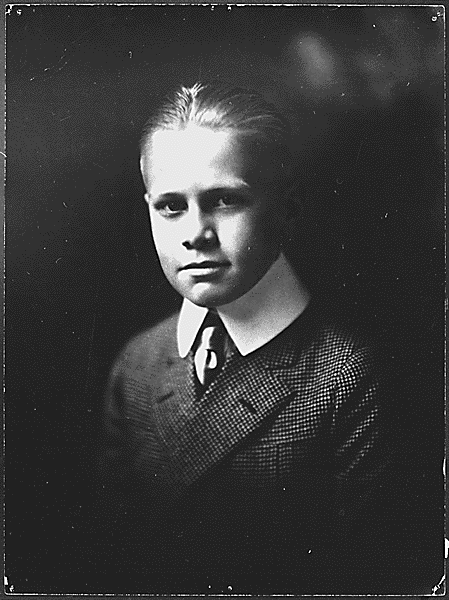
Gerald Rudolph Ford, the 38th President of the United States, was born Leslie Lynch King, Jr., the son of Leslie Lynch King and Dorothy Ayer Gardner King, on July 14, 1913, in Omaha, Nebraska. His parents separated two weeks after his birth and his mother took him to Grand Rapids, Michigan to live with her parents. On February 1, 1916, approximately two years after her divorce was final, Dorothy King married Gerald R. Ford, a Grand Rapids paint salesman. The Fords began calling her son Gerald R. Ford, Jr., although his name was not legally changed until December 3, 1935. He had known since he was thirteen years old that Gerald Ford, Sr., was not his biological father, but it was not until 1930 when Leslie King made an unexpected stop in Grand Rapids that he had a chance meeting with this biological father. The future president grew up in a close-knit family which included three younger half-brothers, Thomas, Richard, and James.
Ford attended South High School in Grand Rapids, where he excelled scholastically and athletically, being named to the honor society and the "All-City" and "All-State" football teams. He was also active in scouting, achieving the rank of Eagle Scout in November 1927. He earned spending money by working in the family paint business and at a local restaurant.
From 1931 to 1935 Ford attended The University of Michigan at Ann Arbor, where he majored in economics and political science. He graduated with a B.A. degree in June 1935. He financed his education with part-time jobs, a small scholarship from his high school, and modest family assistance. A gifted athlete, Ford played on the University's national championship football teams in 1932 and 1933. He was voted the Wolverine's most valuable player in 1934 and on January 1, 1935, played in the annual East-West College All-Star game in San Francisco, for the benefit of the Shrine Crippled Children's Hospital. In August 1935 he played in the Chicago Tribune College All-Star football game at Soldier Field against the Chicago Bears.
He received offers from two professional football teams, the Detroit Lions and the Green Bay Packers, but chose instead to take a position as boxing coach and assistant varsity football coach at Yale hoping to attend law school there. Among those he coached were future U.S. Senators Robert Taft, Jr. and William Proxmire. Yale officials initially denied him admission to the law school, because of his full-time coaching responsibilities, but admitted him in the spring of 1938. Ford earned his LL.B. degree in 1941, graduating in the top 25 percent of his class in spite of the time he had to devote to his coaching duties. His introduction to politics came in the summer of 1940 when he worked in Wendell Willkie's presidential campaign.
After returning to Michigan and passing his bar exam, Ford and a University of Michigan fraternity brother, Philip A. Buchen (who later served on Ford's White House staff as Counsel to the President), set up a law partnership in Grand Rapids. He also taught a course in business law at the University of Grand Rapids and served as line coach for the school's football team. He had just become active in a group of reform-minded Republicans in Grand Rapids, calling themselves the Home Front, who were interested in challenging the hold of local political boss Frank McKay, when the United States entered World War II.
In April 1942 Ford joined the U.S. Naval Reserve receiving a commission as an ensign. After an orientation program at Annapolis, he became a physical fitness instructor at a pre- flight school in Chapel Hill, North Carolina. In the spring of 1943 he began service in the light aircraft carrier USS MONTEREY. He was first assigned as athletic director and gunnery division officer, then as assistant navigator, with the MONTEREY which took part in most of the major operations in the South Pacific, including Truk, Saipan, and the Philippines. His closest call with death came not as a result of enemy fire, however, but during a vicious typhoon in the Philippine Sea in December 1944. He came within inches of being swept overboard while the storm raged. The ship, which was severely damaged by the storm and the resulting fire, had to be taken out of service. Ford spent the remainder of the war ashore and was discharged as a lieutenant commander in February 1946.
When he returned to Grand Rapids Ford became a partner in the locally prestigious law firm of Butterfield, Keeney, and Amberg. A self-proclaimed compulsive "joiner," Ford was well-known throughout the community. Ford has stated that his experiences in World War II caused him to reject his previous isolationist leanings and adopt an internationalist outlook. With the encouragement of his stepfather, who was county Republican chairman, the Home Front, and Senator Arthur Vandenberg, Ford decided to challenge the isolationist incumbent Bartel Jonkman for the Republican nomination for the U.S. House of Representatives in the 1948 election. He won the nomination by a wide margin and was elected to Congress on November 2, receiving 61 percent of the vote in the general election.
During the height of the campaign Gerald Ford married Elizabeth Anne Bloomer Warren, a department store fashion consultant. They were to have four children: Michael Gerald, born March 14, 1950; John Gardner, born March 16, 1952; Steven Meigs, born May 19, 1956; and Susan Elizabeth, born July 6, 1957.
Gerald Ford served in the House of Representatives from January 3, 1949 to December 6, 1973, being reelected twelve times, each time with more than 60% of the vote. He became a member of the House Appropriations Committee in 1951, and rose to prominence on the Defense Appropriations Subcommittee, becoming its ranking minority member in 1961. He once described himself as "a moderate in domestic affairs, an internationalist in foreign affairs, and a conservative in fiscal policy."
As his reputation as a legislator grew, Ford declined offers to run for both the Senate and the Michigan governorship in the early 1950s. His ambition was to become Speaker of the House. In 1960 he was mentioned as a possible running mate for Richard Nixon in the presidential election. In 1961, in a revolt of the "Young Turks," a group of younger, more progressive House Republicans who felt that the older leadership was stagnating, Ford defeated sixty-seven year old Charles Hoeven of Iowa for Chairman of the House Republican Conference, the number three leadership position in the party.
In 1963 President Johnson appointed Ford to the Warren Commission investigating the assassination of President John F. Kennedy. In 1965 Ford co-authored, with John R. Stiles, a book about the findings of the Commission, Portrait of the Assassin. President Ford is the last living member of the Warren Commission.
The battle for the 1964 Republican nomination for president was drawn on ideological lines, but Ford avoided having to choose between Nelson Rockefeller and Barry Goldwater by standing behind Michigan favorite son George Romney.
In 1965 Ford was chosen by the Young Turks as their best hope to challenge Charles Halleck for the position of minority leader of the House. He won by a small margin and took over the position early in 1965, holding it for eight years.
Ford led Republican opposition to many of President Johnson's programs, favoring more conservative alternatives to his social welfare legislation and opposing Johnson's policy of gradual escalation in Vietnam. As minority leader Ford made more than 200 speeches a year all across the country, a circumstance which made him nationally known.
In both the 1968 and 1972 elections Ford was a loyal supporter of Richard Nixon, who had been a friend for many years. In 1968 Ford was again considered as a vice presidential candidate. Ford backed the President's economic and foreign policies and remained on good terms with both the conservative and liberal wings of the Republican party.
Because the Republicans did not attain a majority in the House, Ford was unable to reach his ultimate political goal--to be Speaker of the House. Ironically, he did become president of the Senate. When Spiro Agnew resigned the office of Vice President of the United States late in 1973, after pleading no contest to a charge of income tax evasion, President Nixon was empowered by the 25th Amendment to appoint a new vice president. Presumably, he needed someone who could work with Congress, survive close scrutiny of his political career and private life, and be confirmed quickly. He chose Gerald R. Ford. Following the most thorough background investigation in the history of the FBI, Ford was confirmed and sworn in on December 6, 1973.
The specter of the Watergate scandal, the break-in at Democratic headquarters during the 1972 campaign and the ensuing cover-up by Nixon administration officials, hung over Ford's nine-month tenure as vice president. When it became apparent that evidence, public opinion, and the mood in Congress were all pointing toward impeachment, Nixon became the first president in U.S. history to resign from that office.
Gerald R. Ford took the oath of office as President of the United States on August 9, 1974, stating that "the long national nightmare is over. Our Constitution works."
Within the month Ford nominated Nelson Rockefeller for vice president. On December 19, 1974, Rockefeller was confirmed by Congress, over the opposition of many conservatives, and the country had a full complement of leaders again.
One of the most difficult decisions of Ford's presidency was made just a month after he took office. Believing that protracted impeachment proceedings would keep the country mired in Watergate and unable to address the other problems facing it, Ford decided to grant a pardon to Richard Nixon prior to the filing of any formal criminal charges. Public reaction was mostly negative; Ford was even suspected of having made a "deal" with the former president to pardon him if he would resign. The decision may have cost him the election in 1976, but President Ford always maintained that it was the right thing to do for the good of the country.
President Ford inherited an administration plagued by a divisive war in Southeast Asia, rising inflation, and fears of energy shortages. He faced many difficult decisions including replacing Nixon's staff with his own, restoring the credibility of the presidency, and dealing with a Congress increasingly assertive of its rights and powers.
In domestic policy, President Ford felt that through modest tax and spending cuts, deregulating industries, and decontrolling energy prices to stimulate production, he could contain both inflation and unemployment. This would also reduce the size and role of the federal government and help overcome the energy shortage. His philosophy is best summarized by one of his favorite speech lines, "A government big enough to give us everything we want is a government big enough to take from us everything we have." The heavily Democratic Congress often disagreed with Ford, leading to numerous confrontations and his frequent use of the veto to control government spending. Through compromise, bills involving energy decontrol, tax cuts, deregulation of the railroad and securities industries, and antitrust law reform were approved.
In foreign policy, Ford and Secretary of State Kissinger continued the policy of detente with the Soviet Union and "shuttle diplomacy" in the Middle East. U.S.-Soviet relations were marked by on-going arms negotiations, the Helsinki agreements on human rights principles and East European national boundaries, trade negotiations, and the symbolic Apollo-Soyuz joint manned space flight. Ford's personal diplomacy was highlighted by trips to Japan and China, a 10-day European tour, and co-sponsorship of the first international economic summit meeting, as well as the reception of numerous foreign heads of state, many of whom came in observance of the U.S. Bicentennial in 1976.
With the fall of South Vietnam in 1975 as background, Congress and the President struggled repeatedly over presidential war powers, oversight of the CIA and covert operations, military aid appropriations, and the stationing of military personnel.
On May 14, 1975, in a dramatic move, Ford ordered U.S. forces to retake the S.S. MAYAGUEZ, an American merchant ship seized by Cambodian gunboats two days earlier in international waters. The vessel was recovered and all 39 crewmen saved. In the preparation and execution of the rescue, however, 41 Americans lost their lives.
On two separate trips to California in September 1975, Ford was the target of assassination attempts. Both of the assailants were women -- Lynette "Squeaky" Fromme and Sara Jane Moore.
During the 1976 campaign, Ford fought off a strong challenge by Ronald Reagan to gain the Republican nomination. He chose Senator Robert Dole of Kansas as his running mate and succeeded in narrowing Democrat Jimmy Carter's large lead in the polls, but finally lost one of the closest elections in history. Three televised candidate debates were focal points of the campaign.
Upon returning to private life, President and Mrs. Ford moved to California where they built a new house in Rancho Mirage. President Ford's memoir, A Time to Heal: The Autobiography of Gerald R. Ford, was published in 1979. After leaving office, President Ford continued to actively participate in the political process and to speak out on important political issues. He lectured at hundreds of colleges and universities, on such issues as Congressional/White House relations, federal budget policies, and domestic and foreign policy issues. He attended the annual Public Policy Week Conferences of the American Enterprise Institute, and in 1982 established the AEI World Forum, which he hosted for many years in Vail/Beaver Creek, Colorado. This was an international gathering of former and current world leaders and business executives to discuss political and business policies impacting current issues.
In 1981, the Gerald R. Ford Library in Ann Arbor, Michigan, and the Gerald R. Ford Museum in Grand Rapids, Michigan, were dedicated. President Ford has participated in conferences at either site dealing with such subjects as the Congress, the presidency and foreign policy; Soviet-American relations; German reunification, the Atlantic Alliance, and the future of American foreign policy; national security requirements for the ‘90s; humor and the presidency; and the role of First Ladies. The former President is the recipient of numerous awards and honors by many civic organizations. He is the recipient of many honorary Doctor of Law degrees from various public and private colleges and universities.
Gerald R. Ford Library
http://www.fordlibrarymuseum.gov/library/aboutlib.asp
Gerald R. Ford Library
1000 Beal Avenue
Ann Arbor, MI 48109
Telephone: (734) 205-0555
Fax: (734) 205-0571
Open Monday - Friday, 8:45 a.m. - 4:45 p.m.. Closed Federal holidays.
The Gerald R. Ford Library collects, preserves, and makes accessible to the public a rich body of archival materials on U.S. domestic issues, foreign relations, and political affairs during the Cold War era. Current holdings include 21 million pages of memos, letters, meeting notes, reports, and other historical documents. Also there are one-half million audiovisual items, including photographs, videotapes of news broadcasts, audiotapes of speeches and press briefings, film of public events, and televised campaign commercials. The 1974-77 presidential papers of Gerald Ford and his White House staff form the core collection. These are supplemented by the pre- and post-presidential papers of Gerald Ford, the papers of Betty Ford, collections of Federal records, and more. Former government officials have donated personal papers, researchers in the period have given copies of research interviews, and private individuals associated with the issues and events of the time have given their materials. The Library serves students of all ages, scholars, mass media production staff, government officials, journalists, and others regardless of national citizenship. The Library is located in Ann Arbor, Michigan, on the North Campus of the University of Michigan, Gerald Ford's alma mater (B.A., 1935). The Library is part of the Presidential libraries system of the National Archives and Records Administration, a Federal agency. Unlike other Presidential libraries, the museum component is geographically separate from the library/archives. The Ford Museum is in Grand Rapids, Michigan, 130 miles west of Ann Arbor, in Gerald Ford's hometown and the congressional district he represented from 1949-73. Despite the separation, the library and museum are a single institution sharing one director.
Basic Facts:
Groundbreaking - January 15, 1979
Opened to the public - April 27, 1981
Cost of construction - $4.3 million
Square footage - 50,000 square feet
Staffing - 10.5 FTE plus Director
Collections/Holdings
Documents - 23 million pages
Still photographs - 325,000
Video - 3,500 hours
Audio - 3,000 hours
Motion picture film - 787,0007 feet
Research Statistics (in FY 2005)
Research cards - 473
Research visits - 1033
Reference inquiries - 1932
Reproductions provided - 46,034
Gerald R. Ford Library
1000 Beal Avenue
Ann Arbor, MI 48109
Telephone: (734) 205-0555
Fax: (734) 205-0571
Open Monday - Friday, 8:45 a.m. - 4:45 p.m.. Closed Federal holidays.
The Gerald R. Ford Library collects, preserves, and makes accessible to the public a rich body of archival materials on U.S. domestic issues, foreign relations, and political affairs during the Cold War era. Current holdings include 21 million pages of memos, letters, meeting notes, reports, and other historical documents. Also there are one-half million audiovisual items, including photographs, videotapes of news broadcasts, audiotapes of speeches and press briefings, film of public events, and televised campaign commercials. The 1974-77 presidential papers of Gerald Ford and his White House staff form the core collection. These are supplemented by the pre- and post-presidential papers of Gerald Ford, the papers of Betty Ford, collections of Federal records, and more. Former government officials have donated personal papers, researchers in the period have given copies of research interviews, and private individuals associated with the issues and events of the time have given their materials. The Library serves students of all ages, scholars, mass media production staff, government officials, journalists, and others regardless of national citizenship. The Library is located in Ann Arbor, Michigan, on the North Campus of the University of Michigan, Gerald Ford's alma mater (B.A., 1935). The Library is part of the Presidential libraries system of the National Archives and Records Administration, a Federal agency. Unlike other Presidential libraries, the museum component is geographically separate from the library/archives. The Ford Museum is in Grand Rapids, Michigan, 130 miles west of Ann Arbor, in Gerald Ford's hometown and the congressional district he represented from 1949-73. Despite the separation, the library and museum are a single institution sharing one director.
Basic Facts:
Groundbreaking - January 15, 1979
Opened to the public - April 27, 1981
Cost of construction - $4.3 million
Square footage - 50,000 square feet
Staffing - 10.5 FTE plus Director
Collections/Holdings
Documents - 23 million pages
Still photographs - 325,000
Video - 3,500 hours
Audio - 3,000 hours
Motion picture film - 787,0007 feet
Research Statistics (in FY 2005)
Research cards - 473
Research visits - 1033
Reference inquiries - 1932
Reproductions provided - 46,034
Remembering Gerald Ford
http://www.ford.utexas.edu/museum/aboutmus.asp
Gerald R. Ford Museum
303 Pearl Street NW
Grand Rapids, MI 49504-5353
Telephone: (616) 254-0400
Fax: (616) 254-0386
Open daily from 9:00 am - 5:00 pm.
(Closed New Year's Day, Thanksgiving Day, and Christmas Day).
The permanent exhibits are the core of the Museum's program. They allow visitors to participate in history, not just view it, while reviewing the highlights of the lives of President and Mrs. Ford. In addition to the permanent exhibits, a succession of temporary exhibits draw upon the rich holdings of the entire Presidential libraries system, the Smithsonian Institution, the National Archives, and others. Not all museum programs revolve around the exhibits schedule. Museum staff organize and and host special events, everything from a 1940s fashion show to activities for school children. The Museum also hosts naturalization ceremonies for new citizens and opens the grounds to the community festivities and fireworks on the fourth of July. The Museum Store sells items relating to President and Mrs. Ford and other Presidents and First Ladies, along with a number of souvenirs. Where the Ford Library offers an analytic approach to our past and our government, the museum provokes emotions that stimulate learning, reflection, and a sense of democratic citizenship. For visitors, the presidency is theirs to see and touch (almost), to use, and to hold accountable. The Ford Museum opened to the public in September 1981. It is part of the Presidential libraries system of the National Archives and Records Administration, a Federal agency. Unlike other Presidential libraries, the museum component is geographically separate from the library/archives. The Ford Museum is in Grand Rapids, Michigan and the Library is in Ann Arbor, Michigan. Despite the separation, the library and museum are a single institution sharing one director.
Gerald R. Ford Museum
303 Pearl Street NW
Grand Rapids, MI 49504-5353
Telephone: (616) 254-0400
Fax: (616) 254-0386
Open daily from 9:00 am - 5:00 pm.
(Closed New Year's Day, Thanksgiving Day, and Christmas Day).
The permanent exhibits are the core of the Museum's program. They allow visitors to participate in history, not just view it, while reviewing the highlights of the lives of President and Mrs. Ford. In addition to the permanent exhibits, a succession of temporary exhibits draw upon the rich holdings of the entire Presidential libraries system, the Smithsonian Institution, the National Archives, and others. Not all museum programs revolve around the exhibits schedule. Museum staff organize and and host special events, everything from a 1940s fashion show to activities for school children. The Museum also hosts naturalization ceremonies for new citizens and opens the grounds to the community festivities and fireworks on the fourth of July. The Museum Store sells items relating to President and Mrs. Ford and other Presidents and First Ladies, along with a number of souvenirs. Where the Ford Library offers an analytic approach to our past and our government, the museum provokes emotions that stimulate learning, reflection, and a sense of democratic citizenship. For visitors, the presidency is theirs to see and touch (almost), to use, and to hold accountable. The Ford Museum opened to the public in September 1981. It is part of the Presidential libraries system of the National Archives and Records Administration, a Federal agency. Unlike other Presidential libraries, the museum component is geographically separate from the library/archives. The Ford Museum is in Grand Rapids, Michigan and the Library is in Ann Arbor, Michigan. Despite the separation, the library and museum are a single institution sharing one director.
Tuesday, October 31, 2006
Flowers Feed Also the Soul
Soon as man was sufficiently civilized to have any appreciation of the aesthetic, he became vividly aware of the beauty of Nature's blossoms. There followed a symbolic and mystic attribution to these of qualities and meanings. Beautiful and poetical thoughts were conveyed by the presentation of a sprig of blossom, and whole messages were communicated by bouquets in which each flower chosen betokened a significant idea. Not only love and happiness were the tenor of these floral missives; coquetry, dalliance, prevarication, indifference and coolness; rebuff, refusal, scorn, contempt and insult-all were expressed by a suitably chosen flower. Needless to say, the practice of using floral emblems was so convenient that it became firmly established in favor near and far. From the Occident to the Orient, these messages were current. A floral love-token handed to the favored one by a slave or a henchman could tell no tale to irate parent or spouse-at least no such tale as could an intercepted letter.
But the system was open to falsification. The messenger might hand the missive to a person other than the one for whom it was intended; late at night, or in the half-light of dawn, the hopeful knight-errant would appear at the garden gate to carry off his beloved, and she would fail, perhaps, to realize until too late the deception that had been practiced upon her. Or the flower might be substituted by another having a meaning that was far different from the one intended, so that unwittingly the maiden would give her admirer his conge'.
Despite its liability to unhappy breakdowns of this nature, florigraphy has flourished down to our own day, and the modem revival in the sending of valentines has fostered it. Floral cards for birthday messages are also very popular. To the discriminating sender and appreciative recipient, an aptly chosen spray of blossoms may mean much; only the most heedless or uninformed Would choose flowers at random. (http://www.vangelis.com.au/flowers.asp)
For those interested in the historic meanings of flowers, the Society of American Florists has compiled this list from a variety of different sources: (http://www.aboutflowers.com/floral_b5.html)
Amaryllis dramatic
Anemone fragile
Apple Blossom promise
Aster contentment
Azalea abundance
Baby's Breath festivity
Black-Eyed Susan encouragement
Camellia graciousness
Cosmos peaceful
Crocus foresight
Daffodil chivalry
Delphinium boldness
Daisy innocence
Freesia spirited
Gardenia joy
Heather solitude
Hibiscus delicate beauty
Holly domestic happiness
Hyacinth sincerity
Hydrangea perseverance
Iris inspiration
Ivy fidelity
Jasmine grace and elegance
Lavender distrust
Lilac first love
Stargazer Lily ambition
Calla Lily regal
Magnolia dignity
Marigold desire for riches
Orchid delicate beauty
Pansy loving thoughts
Peony healing
Poppy consolation
red rose passionate love
Sweetpea shyness
Violet faithfulness
But the system was open to falsification. The messenger might hand the missive to a person other than the one for whom it was intended; late at night, or in the half-light of dawn, the hopeful knight-errant would appear at the garden gate to carry off his beloved, and she would fail, perhaps, to realize until too late the deception that had been practiced upon her. Or the flower might be substituted by another having a meaning that was far different from the one intended, so that unwittingly the maiden would give her admirer his conge'.
Despite its liability to unhappy breakdowns of this nature, florigraphy has flourished down to our own day, and the modem revival in the sending of valentines has fostered it. Floral cards for birthday messages are also very popular. To the discriminating sender and appreciative recipient, an aptly chosen spray of blossoms may mean much; only the most heedless or uninformed Would choose flowers at random. (http://www.vangelis.com.au/flowers.asp)
For those interested in the historic meanings of flowers, the Society of American Florists has compiled this list from a variety of different sources: (http://www.aboutflowers.com/floral_b5.html)
Amaryllis dramatic
Anemone fragile
Apple Blossom promise
Aster contentment
Azalea abundance
Baby's Breath festivity
Black-Eyed Susan encouragement
Camellia graciousness
Cosmos peaceful
Crocus foresight
Daffodil chivalry
Delphinium boldness
Daisy innocence
Freesia spirited
Gardenia joy
Heather solitude
Hibiscus delicate beauty
Holly domestic happiness
Hyacinth sincerity
Hydrangea perseverance
Iris inspiration
Ivy fidelity
Jasmine grace and elegance
Lavender distrust
Lilac first love
Stargazer Lily ambition
Calla Lily regal
Magnolia dignity
Marigold desire for riches
Orchid delicate beauty
Pansy loving thoughts
Peony healing
Poppy consolation
red rose passionate love
Sweetpea shyness
Violet faithfulness
Shades of Gray
If you haven't taken some time to meet singer-songwriter David Gray then you are missing out. Born in England, he moved to Wales and then back to Liverpool for college. Although he had some other followers especially in Ireland, his breakthrough song was Babylon ("Only wish that you were here ~You know I'm seeing it so clear ~I've been afraid ~To tell you how I really feel ~Admit to some of those bad mistakes I've made") which is a beautifully haunting song, like waves crashing on a beach on a cold day.
Gray's early music was in a contemporary folk-rock, singer-songwriter mode; his primary instrument was acoustic guitar and piano. Starting with the release of White Ladder in 1999, Gray began to make significant use of computer-generated music to accompany his voice and acoustic instrumentation, a technique which differentiates him from many of his peers. Despite the move to more complex music, Gray has used small-scale, often home-based, recording methods and equipment and espoused a do it yourself approach to music production.
David says that (the title) “brings all kinds of images to mind, time lapse photography or someone standing still. But the sentiments of that are that I think we’re so impregnated with film and moving imagery that sometimes in your life when something happens like an accident, or someone dies, or someone’s born-whatever it happens to be-time seems to play a trick on you and the whole thing just seems utterly unreal. You’re so used to processing reality at a certain pace, as if it’s some kind of edited TV programme. "
Here are some of his lyrics. Feel the hot cup of cocoa on a cold day in the warmth of his songs.
This Years Love
This years love had better last
Heaven knows it's high time
And I've been waiting on my own too long
But when you hold me like you do
It feels so right I start to forget
How my heart gets torn
When that hurt gets thrown
Feeling like you can't go on
Turning circles when time again...
Before I open up my arms and fall
Losing all control
Every dream inside my soul
And when you kiss me
On that midnight street
Sweep me off my feet
Singing ain't this life so sweet
This years love had better last
This years love had better last
Sail Away
Sail away with me honey
I put my heart in your hands
Sail away with me honey now, now, now
Sail away with me
What will be will be I wanna hold you now
Crazy skies all wild above me now
Winter howling at my face
And everything I held so dear
Disappeared without a trace
Oh all the times I've tasted love
Never knew quite what I had
Little Darling if you hear me now
Never needed you so bad
Now and Always
You're in my mind baby
Now and always
You're in my mind baby
Now and always
The road I'm walking
Might fall away
You're in my mind baby
Now and always
A bonfire smoking
Into a low sky
The sparks they fly up
Into a low sky
Would that these demons
Would let me rest
The One I Love
Gonna close my eyes
Girl and watch you go
Running through this life darling
Like a field of snow
As the tracer glides
In its graceful arc
Send a little prayer out...and the stars above
You're the one I love
Perfect summers night
Not a wind that breathes
Just the bullets whispering gentle
Amongst the new green leaves
There's things I might have said
Only wish I could ...
Next wave coming in
Like an ocean roar
Won't you take my hand darling
On that old dance floor
We can twist and shout
Do the turtle dove
And you're the one I love
You're the one I love
The one I love
Freedom
Take your eyes off me
There's nothing here to see
Just trying to keep my head together
And as we make our vow
Let us remember how
There's nothing good that lasts forever.
Time out on the running boards
We're running through a world that's lost its meaning
Trying to find a way to love
As I'm Leaving
As I'm leaving
A change comes on my eyes
These streets persuading me
With mumbled strange goodbyes
Through the water
Through the rain
To the soul of everything
Throw my heart out on the stones
And I'm almost gone
There's no meaning
In clothes and coffee cups
Cheap hotel furniture
Where silence never stops
Through the water
Through the rain
To the soul of everything
Throw my memories to the wind
And I'm almost gone
And now I'm dreaming
I'm staring at the walls
Cars are frozen now
In late night waterfalls
Through the water
Through the rain
To the soul of everything
Throw my heart out on the stones
And I'm almost
Through the water
Through the rain
To the soul of everything
Wash my heart out on the stones
And I'm almost gone
Gray's early music was in a contemporary folk-rock, singer-songwriter mode; his primary instrument was acoustic guitar and piano. Starting with the release of White Ladder in 1999, Gray began to make significant use of computer-generated music to accompany his voice and acoustic instrumentation, a technique which differentiates him from many of his peers. Despite the move to more complex music, Gray has used small-scale, often home-based, recording methods and equipment and espoused a do it yourself approach to music production.
David says that (the title) “brings all kinds of images to mind, time lapse photography or someone standing still. But the sentiments of that are that I think we’re so impregnated with film and moving imagery that sometimes in your life when something happens like an accident, or someone dies, or someone’s born-whatever it happens to be-time seems to play a trick on you and the whole thing just seems utterly unreal. You’re so used to processing reality at a certain pace, as if it’s some kind of edited TV programme. "
Here are some of his lyrics. Feel the hot cup of cocoa on a cold day in the warmth of his songs.
This Years Love
This years love had better last
Heaven knows it's high time
And I've been waiting on my own too long
But when you hold me like you do
It feels so right I start to forget
How my heart gets torn
When that hurt gets thrown
Feeling like you can't go on
Turning circles when time again...
Before I open up my arms and fall
Losing all control
Every dream inside my soul
And when you kiss me
On that midnight street
Sweep me off my feet
Singing ain't this life so sweet
This years love had better last
This years love had better last
Sail Away
Sail away with me honey
I put my heart in your hands
Sail away with me honey now, now, now
Sail away with me
What will be will be I wanna hold you now
Crazy skies all wild above me now
Winter howling at my face
And everything I held so dear
Disappeared without a trace
Oh all the times I've tasted love
Never knew quite what I had
Little Darling if you hear me now
Never needed you so bad
Now and Always
You're in my mind baby
Now and always
You're in my mind baby
Now and always
The road I'm walking
Might fall away
You're in my mind baby
Now and always
A bonfire smoking
Into a low sky
The sparks they fly up
Into a low sky
Would that these demons
Would let me rest
The One I Love
Gonna close my eyes
Girl and watch you go
Running through this life darling
Like a field of snow
As the tracer glides
In its graceful arc
Send a little prayer out...and the stars above
You're the one I love
Perfect summers night
Not a wind that breathes
Just the bullets whispering gentle
Amongst the new green leaves
There's things I might have said
Only wish I could ...
Next wave coming in
Like an ocean roar
Won't you take my hand darling
On that old dance floor
We can twist and shout
Do the turtle dove
And you're the one I love
You're the one I love
The one I love
Freedom
Take your eyes off me
There's nothing here to see
Just trying to keep my head together
And as we make our vow
Let us remember how
There's nothing good that lasts forever.
Time out on the running boards
We're running through a world that's lost its meaning
Trying to find a way to love
As I'm Leaving
As I'm leaving
A change comes on my eyes
These streets persuading me
With mumbled strange goodbyes
Through the water
Through the rain
To the soul of everything
Throw my heart out on the stones
And I'm almost gone
There's no meaning
In clothes and coffee cups
Cheap hotel furniture
Where silence never stops
Through the water
Through the rain
To the soul of everything
Throw my memories to the wind
And I'm almost gone
And now I'm dreaming
I'm staring at the walls
Cars are frozen now
In late night waterfalls
Through the water
Through the rain
To the soul of everything
Throw my heart out on the stones
And I'm almost
Through the water
Through the rain
To the soul of everything
Wash my heart out on the stones
And I'm almost gone
Star Light, Star Bright
This is my tribute to the **stars**
You're the star I love to look at each night, a star I can't reach. I'm a fool who doesn't know when to quit. Maybe, I just don't want to. 'Cause maybe, just maybe, my star would someday fall for me...
My star in the sixth grade science lesson was Cassiopeia...
Cassiopeia is a northern constellation which greek mythology considered to represent a vain queen. It is one of the 88 modern constellations, and was also one of the 48 listed by Ptolemy. Cassiopeia contains two stars visible to the naked eye that rank among the most luminous in the galaxy. This beautiful constellation at the edge of the Milky Way has definetely the shape of a "W". It is associated with the Perseus constellation family.
Cassiopeia is one of the stars that orbits the Polestar throughout the year. It is shaped like a W, with a makeup of five second- and third-magnitude stars, and has been a well-known constellation since ancient times. It contains about 370 variable stars and the large variety of clusters and binaries make it easily viewable with even a small telescope. It has been known in ancient Japan as the "Yamagata Star" and "Ikari Star." After dark in Fall months, turn your back on the direction the sun went down and then shift a bit northward; you will be looking to the north-east. Starting straight overhead at the zenith, measure 2 palm-widths down towards the northeast. You will see there a group of five stars forming a "lazy M". This is the constellation Cassiopeia, or "Cassiopeia's Chair". You can see why it is also called the "Celestial M". As the night progresses, this northern constellation swings counterclockwise around the polestar Polaris and towards morning will become the "Celestial W".
Mythology
Cassiopeia was a queen and the wife of Cepheus, the Ethiopian king of Joppa (now known as Jaffa, in Israel), and the mother of Andromeda. The queen was both beautiful and vain, and the story of how her vanity caused great distress is told in relation to the constellation Andromeda. After promising her daughter in marriage to Perseus, Cassiopeia had second thoughts. She convinced one of Poseidon's sons, Agenor, to disrupt the ceremony by claiming Andromeda for himself. Agenor arrived with an entire army, and a fierce struggle ensued. In the battle Cassiopeia is said to have cried "Perseus must die". At any rate it was Perseus who was victorious, with the help of the Gorgon's head. Perseus had recently slain Medusa, the Gorgon, and had put its head in a bed of coral. He retrieved the head and waved it in midst of the warring wedding party, instantly turning them all to stone. In the group was both Cepheus and Cassiopeia. A contrite Poseidon put both father and mother in the heavens. But because of Cassiopeia's vanity, he placed her in a chair which revolves around the Pole Star, so half the time she's obliged to sit upside down.
*************************************
"O Star" by Robert Frost
O Star (the fairest one in sight),
We grant your loftiness the right
To some obscurity of cloud-
It will not do to say of night,
Since dark is what brings out your light.
Some mystery becomes the proud.
But to be wholly taciturnIn your reserve is not allowed.
Say something to us we an learn
By heart and when alone repeat.Say something!
And it says, "I burn."
But say with what degree of heat.
Talk Fahrenheit, talk Centigrade.
Use language we can comprehend.
Tell us what elements you blend.
It gives us strangely little aid,
But does tell something in the end.
And steadfast as Keats' Eremite,
Not even stooping from its sphere,
It asks a little of us here.
It asks of us a certain height,
So when at times the mob is swayed
To carry praise or blame too far,
We may take something like a star
To stay our minds on and be staid.
***************************************
"Catch A Falling Star" by Perry Como
Catch a falling star and put it in your pocket
Never let it fade away
Catch a falling star and put it in your pocket
Save it for a rainy day
For love may come and tap you on the shoulder some starless night
Just in case you feel you want to hold her
You'll have a pocketful of starlight
Catch a falling star and put it in your pocket
Never let it fade away
Catch a falling star and put it in your pocket
Save it for a rainy day
For love may come and tap you on the shoulder some starless night
Just in case you feel you want to hold herYou'll have a pocketful of starlight
Catch a falling star and put it in your pocke
tNever let it fade away
Catch a falling star and put it in your pocket
Save it for a rainy day
For when your troubles start multiplyin' and they just might
It's easy to forget them without tryin'
With just a pocketful of starlight
Catch a falling star and put it in your pocket
Never let it fade away
Catch a falling star and put it in your pocket
Save it for a rainy day
*************************************************
You're the star I love to look at each night, a star I can't reach. I'm a fool who doesn't know when to quit. Maybe, I just don't want to. 'Cause maybe, just maybe, my star would someday fall for me...
My star in the sixth grade science lesson was Cassiopeia...
Cassiopeia is a northern constellation which greek mythology considered to represent a vain queen. It is one of the 88 modern constellations, and was also one of the 48 listed by Ptolemy. Cassiopeia contains two stars visible to the naked eye that rank among the most luminous in the galaxy. This beautiful constellation at the edge of the Milky Way has definetely the shape of a "W". It is associated with the Perseus constellation family.
Cassiopeia is one of the stars that orbits the Polestar throughout the year. It is shaped like a W, with a makeup of five second- and third-magnitude stars, and has been a well-known constellation since ancient times. It contains about 370 variable stars and the large variety of clusters and binaries make it easily viewable with even a small telescope. It has been known in ancient Japan as the "Yamagata Star" and "Ikari Star." After dark in Fall months, turn your back on the direction the sun went down and then shift a bit northward; you will be looking to the north-east. Starting straight overhead at the zenith, measure 2 palm-widths down towards the northeast. You will see there a group of five stars forming a "lazy M". This is the constellation Cassiopeia, or "Cassiopeia's Chair". You can see why it is also called the "Celestial M". As the night progresses, this northern constellation swings counterclockwise around the polestar Polaris and towards morning will become the "Celestial W".
Mythology
Cassiopeia was a queen and the wife of Cepheus, the Ethiopian king of Joppa (now known as Jaffa, in Israel), and the mother of Andromeda. The queen was both beautiful and vain, and the story of how her vanity caused great distress is told in relation to the constellation Andromeda. After promising her daughter in marriage to Perseus, Cassiopeia had second thoughts. She convinced one of Poseidon's sons, Agenor, to disrupt the ceremony by claiming Andromeda for himself. Agenor arrived with an entire army, and a fierce struggle ensued. In the battle Cassiopeia is said to have cried "Perseus must die". At any rate it was Perseus who was victorious, with the help of the Gorgon's head. Perseus had recently slain Medusa, the Gorgon, and had put its head in a bed of coral. He retrieved the head and waved it in midst of the warring wedding party, instantly turning them all to stone. In the group was both Cepheus and Cassiopeia. A contrite Poseidon put both father and mother in the heavens. But because of Cassiopeia's vanity, he placed her in a chair which revolves around the Pole Star, so half the time she's obliged to sit upside down.
*************************************
"O Star" by Robert Frost
O Star (the fairest one in sight),
We grant your loftiness the right
To some obscurity of cloud-
It will not do to say of night,
Since dark is what brings out your light.
Some mystery becomes the proud.
But to be wholly taciturnIn your reserve is not allowed.
Say something to us we an learn
By heart and when alone repeat.Say something!
And it says, "I burn."
But say with what degree of heat.
Talk Fahrenheit, talk Centigrade.
Use language we can comprehend.
Tell us what elements you blend.
It gives us strangely little aid,
But does tell something in the end.
And steadfast as Keats' Eremite,
Not even stooping from its sphere,
It asks a little of us here.
It asks of us a certain height,
So when at times the mob is swayed
To carry praise or blame too far,
We may take something like a star
To stay our minds on and be staid.
***************************************
"Catch A Falling Star" by Perry Como
Catch a falling star and put it in your pocket
Never let it fade away
Catch a falling star and put it in your pocket
Save it for a rainy day
For love may come and tap you on the shoulder some starless night
Just in case you feel you want to hold her
You'll have a pocketful of starlight
Catch a falling star and put it in your pocket
Never let it fade away
Catch a falling star and put it in your pocket
Save it for a rainy day
For love may come and tap you on the shoulder some starless night
Just in case you feel you want to hold herYou'll have a pocketful of starlight
Catch a falling star and put it in your pocke
tNever let it fade away
Catch a falling star and put it in your pocket
Save it for a rainy day
For when your troubles start multiplyin' and they just might
It's easy to forget them without tryin'
With just a pocketful of starlight
Catch a falling star and put it in your pocket
Never let it fade away
Catch a falling star and put it in your pocket
Save it for a rainy day
*************************************************
Monday, October 30, 2006
Breast Cancer Awareness
Because it is the end of Breast Cancer Awareness Month, I wanted to post something about using Medline Plus which is a health care site for consumer health information. MedlinePlus will direct you to information to help answer health questions. MedlinePlus brings together authoritative information from NLM, the National Institutes of Health (NIH), and other government agencies and health-related organizations. Preformulated MEDLINE searches are included in MedlinePlus and give easy access to medical journal articles. MedlinePlus also has extensive information about drugs, an illustrated medical encyclopedia, interactive patient tutorials, and latest health news. Visit the site at http://www.medlineplus.gov.
Check this out the entry in the medical encyclopedia for some basic informaiton:
Breast cancer is a malignant (cancerous) growth that begins in the tissues of the breast. Over the course of a lifetime, one in eight women will be diagnosed with breast cancer.
Causes, incidence, and risk factors. There are several different types of breast cancer.
-Ductal carcinoma begins in the cells lining the ducts that bring milk to the nipple and accounts for more than 75% of breast cancers.
-Lobular carcinoma begins in the milk-secreting glands of the breast but is otherwise fairly similar in its behavior to ductal carcinoma. Other varieties of breast cancer can arise from the skin, fat, connective tissues, and other cells present in the breast.
-Some women have what is known as HER2-positive breast cancer. HER2, short for human epidermal growth factor receptor-2, is a gene that helps control cell growth, division, and repair. -When cells have too many copies of this gene, cell growth speeds up. It’s believed that HER2 plays a key role in turning healthy cells into cancerous ones. Some women with breast cancer have too much HER2, and are therefore considered HER2-positive. Research suggests that women with HER2-positive breast cancer have a more aggressive disease and a higher risk of recurrence than those who have HER2 negative breast cancer.
Risk factors for breast cancer include:
-Age and Gender -- As with most cancers, age is a significant factor. In fact, 77% of new cases and 84% of breast cancer deaths occur in women aged 50 and older. More than 80% of breast cancer cases occur in women over 50. Less than 1% of breast cancers occur in men. The risk of breast cancer is clearly related to hormonal influences, but how these affect the disease and particularly types of the disease is not yet clear.
Check this out the entry in the medical encyclopedia for some basic informaiton:
Breast cancer is a malignant (cancerous) growth that begins in the tissues of the breast. Over the course of a lifetime, one in eight women will be diagnosed with breast cancer.
Causes, incidence, and risk factors. There are several different types of breast cancer.
-Ductal carcinoma begins in the cells lining the ducts that bring milk to the nipple and accounts for more than 75% of breast cancers.
-Lobular carcinoma begins in the milk-secreting glands of the breast but is otherwise fairly similar in its behavior to ductal carcinoma. Other varieties of breast cancer can arise from the skin, fat, connective tissues, and other cells present in the breast.
-Some women have what is known as HER2-positive breast cancer. HER2, short for human epidermal growth factor receptor-2, is a gene that helps control cell growth, division, and repair. -When cells have too many copies of this gene, cell growth speeds up. It’s believed that HER2 plays a key role in turning healthy cells into cancerous ones. Some women with breast cancer have too much HER2, and are therefore considered HER2-positive. Research suggests that women with HER2-positive breast cancer have a more aggressive disease and a higher risk of recurrence than those who have HER2 negative breast cancer.
Risk factors for breast cancer include:
-Age and Gender -- As with most cancers, age is a significant factor. In fact, 77% of new cases and 84% of breast cancer deaths occur in women aged 50 and older. More than 80% of breast cancer cases occur in women over 50. Less than 1% of breast cancers occur in men. The risk of breast cancer is clearly related to hormonal influences, but how these affect the disease and particularly types of the disease is not yet clear.
-Genetic Factors and Family History of Breast Cancer -- Some families appear to have a genetic tendency for breast cancer. Two variant genes have been found that appear to account for this: BRCA1 and BRCA2. The genes p53 and BARD1 also appear to be important. Researchers have identified several other defective genes that may cause breast cancer, including BRCA3 and Noey2 (which is a disease inherited only from the father's side of the family). These discoveries suggest that breast cancer occurs when the body’s anti-cancer surveillance and control systems, which normally get rid of abnormal cells, fail to work. The body's reduced ability to get rid of abnormal cells leads to damage that gradually accumulates. Women carrying mutated BRCA1 and/or BRCA2 genes start with pre-existing dysfunction of this system and have a "head start" in this damaging process. Hormones are important because they encourage cell growth. High levels of hormones during a woman's reproductive years, especially when they are not interrupted by the hormonal changes of pregnancy, appear to increase the chances that genetically damaged cells will grow and cause cancer.
-Early Menstruation and Late Menopause -- Women who get their periods early (before age 12) or went through menopause late (after age 55) are at higher risk. Also, women who have never had children or who had them only after the age of 30 have an increased risk.
-Oral Contraceptives (birth control pills) -- Birth control pills may slightly increase the risk for breast cancer, depending on age, length of use, and other factors. No one knows how long the effects of the pill last after stopping it.
-Hormone Replacement Therapy(HRT) -- Use of HRT has been shown to increase the risk of breast cancer.
-Obesity -- Obesity is controversial as a risk factor. Some studies report obesity as a risk of breast cancer, possibly associated with higher levels of estrogen production in obese women.
-Alcohol Consumption -- Significant alcohol use (more than 1-2 drinks a day) has been associated with an increased risk of breast cancer.
-Chemicals -- Some studies have pointed to exposure to estrogen-like chemicals that are found in pesticides and other industrial products as a possible increased risk of breast cancer.
-DES -- Women who took diethylstilbestrol (DES) to prevent miscarriage may have an increased risk of breast cancer after age 40.
Radiation -- People exposed to radiation, particularly during childhood, may face an increased risk for breast cancer in adulthood. Especially at risk are those that received chest irradiation for prior cancers.
-Additional Risk Factors -- Some studies show previous breast, uterine, ovarian, or colon cancer, and a strong history of cancer in the family may increase the risk for breast cancer. Such history may indicate genetic factors described above.
**************
So don't ignore what is important to your health and the health of your female friends and family members. Talk to your doctor, get your tests when you are supposed to get them and keep up on the current medical information on Medline Plus.
Alias & The Wind
I'm watching "Alias" reruns and they have great music clips here and there...songs I love and have forgotten. So I'm going to post some now and then until I can put together a soundtrack listing. Here is a classic from Cat Stevens...
THE WIND
I listen to the wind
to the wind of my soul
Where I'll end up
well I think,
only God really knows
I've sat upon the setting sun
But never,
never never never
I never wanted water once
No, never, never, never
I listen to my words
but they fall far below
I let my music take me where
my heart wants to go
I swam upon the devil's lake
But never,
never never never
I'll never make the same mistake
No, never, never, never
THE WIND
I listen to the wind
to the wind of my soul
Where I'll end up
well I think,
only God really knows
I've sat upon the setting sun
But never,
never never never
I never wanted water once
No, never, never, never
I listen to my words
but they fall far below
I let my music take me where
my heart wants to go
I swam upon the devil's lake
But never,
never never never
I'll never make the same mistake
No, never, never, never
Flashback: Mazzy Star
I have been listening to Mazzy Star's debut album lately and it reminded me how wonderfully poetic the lyrics are and how mystifying the music is. So I thought I'd take you down memory late with me.
Fade into You~Mazzy Star
I want to hold the hand inside you
I want to take a breath thats true
I look to you and I see nothing
I look to you to see the truth
You live your life
You go in shadows
You'll come apart and you'll go black
Some kind of night into your darkness
Colors your eyes with what's not there.
Fade into you
Strange you never knew
Fade into you
I think its strange you never knew
A strangers light comes on slowly
A strangers heart without a home
You put your hands into your head
And then smiles cover your heart
Fade into you
Strange you never knew
Fade into you
I think its strange you never knew
Fade into you
Strange you never knew
Fade into youI
think its strange you never knew
I think its strange you never knew
David Roback and Hope Sandoval are the front figures of Mazzy Star. But Mazzy Star is not a duo, Mazzy Star is a full band. Keith Mitchell, William Cooper, Jill Emery and Suki Ewers are very much anonymous to the public. They are great musicians and are, or have been, important members of the band and should get much more credits than they are given.
David Roback - Guitar, Keyboard, Producer etc.
Hope Sandoval - Vocals, Harmonica, Percusssion, Xylophone, Guitar
Keith Mitchell - Drums
William Cooper - Strings, Keyboard, Bass, Guitar etc.
Jill Emery - Bass
Suki Ewers - Keyboard, Guitar, Bass
Fade into You~Mazzy Star
I want to hold the hand inside you
I want to take a breath thats true
I look to you and I see nothing
I look to you to see the truth
You live your life
You go in shadows
You'll come apart and you'll go black
Some kind of night into your darkness
Colors your eyes with what's not there.
Fade into you
Strange you never knew
Fade into you
I think its strange you never knew
A strangers light comes on slowly
A strangers heart without a home
You put your hands into your head
And then smiles cover your heart
Fade into you
Strange you never knew
Fade into you
I think its strange you never knew
Fade into you
Strange you never knew
Fade into youI
think its strange you never knew
I think its strange you never knew
David Roback and Hope Sandoval are the front figures of Mazzy Star. But Mazzy Star is not a duo, Mazzy Star is a full band. Keith Mitchell, William Cooper, Jill Emery and Suki Ewers are very much anonymous to the public. They are great musicians and are, or have been, important members of the band and should get much more credits than they are given.
David Roback - Guitar, Keyboard, Producer etc.
Hope Sandoval - Vocals, Harmonica, Percusssion, Xylophone, Guitar
Keith Mitchell - Drums
William Cooper - Strings, Keyboard, Bass, Guitar etc.
Jill Emery - Bass
Suki Ewers - Keyboard, Guitar, Bass
- Did you know from http://www.mazzystar.nu/web/facts.asp
Mazzy Star began performing live on the L.A. underground music scene in the late 1980's.
Hope writes nearly all the Mazzy Star lyrics, mostly alone but sometimes together with David Roback. David writes the music.
David Roback has a background in the bands "Rain Parade", "Clay Allison" and "Opal".
"Fade Into You" reached #44 on the Billboard Top 100 chart in 1994.
William Cooper's real name was Will Glenn.
Two of Davids guitars are a Martin 000-28 and, of course, a Fender Telecaster.
Hope Sandoval started her career together with her friend Sylvia Gomez in a band called "Going Home", a folk duo formed in 1986.
The media shy David and Hope have said in an interview that they preferably would do only one interview per album if they could decide by their own.
Jill Emery is a former Hole-member. She has also played in "The Shadow Project".
During the Opal tour in late '87, Kendra Smith left the band. She was replaced by Hope Sandoval and they toured Europe through early 1988.
Keith Mitchell on drums is an ex- Clay Allison and Opal-member. He played in a lot of different bands in the 80's.
Among My Swan, was recorded partly in a basement studio in Berkeley, at a studio called Live Oak that the band has used for its previous records - and partly in London, at the Jesus & Mary Chain's studio and at the Cocteau Twins' studio.
Hope has in an interview named Billie Holiday, the Rolling Stones and Spiritualized as her favorite artists.
Suki Ewers grew up in Seattle but when she was little she and her family lived in Germany, Taiwan, and Okinawa.
Keith Mitchell has played in the bands "Monitor", "The Romans", "Green On Red", "Clay allison", "Opal" and "Chris Cacavas And Junkyard Love" before Mazzy Star.
Hope Sandoval admired Kendra Smith as a teen-age Dream Syndicate fan.
The text font "Mazzy Antique" designed by Michael Diehl for use on Capitol Records' Mazzy Star album, Among My Swan.
Mazzy Star do not enjoy doing interviews and performing live, particularly performing live on television. That´s because they think that "everything they have to say are said on their records".
The DVD "Louder" from the tv show "Later with Jools Holland" includes Mazzy Star performing Blue Flower live.
Hope was born in 1966 and she grow up in east L.A.
"So Tonight That I Might See" went gold a year after its release and made its way to platinum in April of 1995.
Keith Mitchell likes to listen to Bjork, Portishead, Mozart, the Beatles, the Doors, Emmy Lou Harris, Tom Waits, Sun Ra, Rolling Stones, lots of world music, Brecht, etc.
Suki Ewers played keyboards, rhythm guitar (acoustic and electric) and some bass in Mazzy Star.
David Roback got involved (both musically and emotionally) with ex-Dream Syndicate bassist Kendra Smith and formed a new band named Clay Allison in the early '80s.
"Five String Serenade" from the "So Tonight I Might See"-album is written by Arthur Lee from the band "Love".
William Reid of the Jesus & Mary Chain played guitar on "Take Everything" on the Among My Swan-album.
Sandoval lives in Los Angeles, Roback is based in Berkeley, California and Oslo, Norway.
Keith contributed some tracks on Johanna Went's album Posh Boy in 1982.
The album "So Tonight That I Might See" went up to place #36 on the Billboard Top 200 chart in 1994. "Among My Swan" reached #68 in 1996.
Hope sings on the song "Asleep From Day" on Chemical Brothers' album "Surrender".
When Opal was disbanded, David and Hope took the members of Opal and changed their name to Mazzy Star.
Roback produces all of Mazzy Star's recordings.
Steven Roback, Davids brother, have released an album under the name Viva Saturn.
The song "Tell Me Now" is only available on the "Batman Forever" soundtrack.
Hope is singing a duet with Jim Reid called "Sometimes Always" on the Jesus & Mary Chain-album "Stoned & Dethroned". She´s also singing on JAMC's album "Munki", in a song called "Perfume".
The song "Hair And Skin" is written by Dan Stuart from the band "Green On Red".
The particularly subdued "Into Dust" is known within the band as the "Shush Song," a reference to the devoted fans who shush the uninitiated whenever it is performed.
Jason Yates, Paul Olguin, Aaron Sherer and Kurt Elzner have all guest-played with Mazzy Star.
Hope Sandoval sings on Air's "Cherry Blossom Girl (Hope Sandoval version)" from their "Cherry Blossom Girl" single.
Suki Ewers wrote the songs "Strange Delight" and "Brigit on Sunday" to Opal Early Recordings.
Jill Emery is not only a great bass-player, she's also a very gifted painter.
Suki Ewers only played on the "She Hangs Brightly" album but did all the touring on "So Tonight That I Might See" and some shows on the "Among My Swan" tour.
The song "Fade Into You" is played in the movie "Starship Troopers". And in some other movies/tv-shows as well.
Keith's birthday is June 16.
Aaron Sherer (drums) contributed some tracks to She Hangs Brightly, and some drum tracks on Among My Swan ("Take Everything" and "Into Dust").
The song "I'm Gonna Bake My Biscuit" from the Fade Into You CD-single is written by Minnie McCoy.
"Blue Flower" was originally done in the '70s by the band Slapp Happy, written by Peter Blegvad and Anthony Moore.
"Into Dust" was used in the movie "Foxfire". It´s not on the soundtrack-album though.
Suki Ewers started a new band called Anemone in 1993. If she´s still a member of Mazzy Star is unknown.
Samples of "Fade Into You" is mixed together with Jarvis Cocker (Pulp) on vocals in a song called "Into U". It's song #14 on Richard X's album "Presents his X-Factor vol 1."
Sunday, October 29, 2006
Gratitude
Gratitude Vintage Clothing
(214) 522-2921
3714 Fairmount St
Dallas, TX 75219
I'd just like to plug my new friends at Gratitude Vintage Clothing. This little house on the corner of Fairmont, off of Oak Lawn in the Oak Lawn neighborhood of Dallas is a treasure. Every corner is jam packed with beautiful vintage clothing and accessories as well as other treasures that will make for a wonderful day for any person needing a costume for a show or holiday or just a little vintage spice to the every day blah. The first thing I noticed was a pair of vintage red sequened heels that were to die for...if only my foot were that small. Hats line the upper walls and clothing is jammed into every possible rack and hook. I met the owners who are very nice guys who gave kudos to the Oak Lawn library (one has a library science degree & they are members of the Oak Lawn Friends) and one of them gave me a great deal on a vintage raw silk robe and sash for a costume. I would have loved to spend hours in their with the dresses and gloves and jewerly but alas, I will have to return when my time and budget aren't so limited. I give them 5 stars for their awesome customer service--not only did they listen to what I needed, they also listened to me talk about the library and underserved populations. What gentlemen! So think about throwing some kind of costume or theme party or just go find something to heighten your style and go visit my new friends at Gratitude Vintage.
(214) 522-2921
3714 Fairmount St
Dallas, TX 75219
I'd just like to plug my new friends at Gratitude Vintage Clothing. This little house on the corner of Fairmont, off of Oak Lawn in the Oak Lawn neighborhood of Dallas is a treasure. Every corner is jam packed with beautiful vintage clothing and accessories as well as other treasures that will make for a wonderful day for any person needing a costume for a show or holiday or just a little vintage spice to the every day blah. The first thing I noticed was a pair of vintage red sequened heels that were to die for...if only my foot were that small. Hats line the upper walls and clothing is jammed into every possible rack and hook. I met the owners who are very nice guys who gave kudos to the Oak Lawn library (one has a library science degree & they are members of the Oak Lawn Friends) and one of them gave me a great deal on a vintage raw silk robe and sash for a costume. I would have loved to spend hours in their with the dresses and gloves and jewerly but alas, I will have to return when my time and budget aren't so limited. I give them 5 stars for their awesome customer service--not only did they listen to what I needed, they also listened to me talk about the library and underserved populations. What gentlemen! So think about throwing some kind of costume or theme party or just go find something to heighten your style and go visit my new friends at Gratitude Vintage.
Saturday, October 28, 2006
Remembering "The Perfect Storm"
We are coming up on the anniversary of "The Perfect Storm," a real life story of fishermen who lost their lives in a harrowing storm. The story of the Andrea Gail lives on in a book written by Sabastian Junger and a movie of the same name. They featured the families and friends left behind in Gloucester this morning on The Weather Channel so I wanted to take a minute to share the story.
A TRUE STORY OF MEN AGAINST THE SEA
"She's comin' on, boys, and she's comin' on strong," radioed Captain Billy Tyne of the Andrea Gail off the coast of Nova Scotia soon before boat and crew disappeared without a trace. Junger gives us the Halloween storm of 1991 and its effect on the sword fishermen of Gloucester, Massachusetts, with daring high-seas rescues, a history of the fishing industry, the science of storms, and candid accounts of the people whose lives the storm touched.
An enormous extratropical low is creating havoc along the entire Eastern Atlantic Seaboard in this infrared image at 7:00 EST on October 30, 1991. Labelled the "perfect storm" by the National Weather Service, the storm sank the swordfishing boat Andrea Gail, whose story became the basis for the currently best-selling novel "The Perfect Storm" by Sebastian Junger. A little-known and bizarre ending came to this monster, which came to be known as the Halloween Storm. To tell this incredible story in its entirety, the Satellite's Eye Art Gallery spans two subject headings (Extratropical Cyclones and Hurricanes). State by state damage summary reveals the widespread and extensive damage caused by the storm and accompanying seas. Beach erosion and coastal flooding was severe and widespread, even causing damage to lighthouses. Hundreds of homes and businesses were either knocked from their foundations or simply disappeared. Sea walls, boardwalks, bulkheads, and piers were reduced to rubble over a wide area. Numerous small boats were sunk at their berths and thousands of lobster traps were destroyed. Flooding was extensive invading homes and closing roads and airports. Former President Bush's home in Kennebunkport, ME suffered damage as windows were blown out, water flooded the building, and some structural damage also occurred. Even inland areas suffered major damage. The Hudson, Hackensack, and Passaic Rivers all experienced tidal flooding, and high winds brought down utility poles, lines, tree limbs, and signs in several states.
The most extensive damage occurred in New England where federal disaster areas were declared for seven counties in Massachusetts, five in Maine, and one in New Hampshire. Off Staten Island, two men were drowned when their boat capsized. Other fatalities occurred when a man fishing from a bridge was either blown or swept off in New York and a fisherman was swept off the rocks at Narrangansett, RI by heavy surf. Offshore, six lives were lost when the Andrea Gail, a swordfishing boat, sank. Total damage in the Halloween Storm, as it came to be known because of its date, was in the hundreds of millions of dollars.
A TRUE STORY OF MEN AGAINST THE SEA
"She's comin' on, boys, and she's comin' on strong," radioed Captain Billy Tyne of the Andrea Gail off the coast of Nova Scotia soon before boat and crew disappeared without a trace. Junger gives us the Halloween storm of 1991 and its effect on the sword fishermen of Gloucester, Massachusetts, with daring high-seas rescues, a history of the fishing industry, the science of storms, and candid accounts of the people whose lives the storm touched.
An enormous extratropical low is creating havoc along the entire Eastern Atlantic Seaboard in this infrared image at 7:00 EST on October 30, 1991. Labelled the "perfect storm" by the National Weather Service, the storm sank the swordfishing boat Andrea Gail, whose story became the basis for the currently best-selling novel "The Perfect Storm" by Sebastian Junger. A little-known and bizarre ending came to this monster, which came to be known as the Halloween Storm. To tell this incredible story in its entirety, the Satellite's Eye Art Gallery spans two subject headings (Extratropical Cyclones and Hurricanes). State by state damage summary reveals the widespread and extensive damage caused by the storm and accompanying seas. Beach erosion and coastal flooding was severe and widespread, even causing damage to lighthouses. Hundreds of homes and businesses were either knocked from their foundations or simply disappeared. Sea walls, boardwalks, bulkheads, and piers were reduced to rubble over a wide area. Numerous small boats were sunk at their berths and thousands of lobster traps were destroyed. Flooding was extensive invading homes and closing roads and airports. Former President Bush's home in Kennebunkport, ME suffered damage as windows were blown out, water flooded the building, and some structural damage also occurred. Even inland areas suffered major damage. The Hudson, Hackensack, and Passaic Rivers all experienced tidal flooding, and high winds brought down utility poles, lines, tree limbs, and signs in several states.
The most extensive damage occurred in New England where federal disaster areas were declared for seven counties in Massachusetts, five in Maine, and one in New Hampshire. Off Staten Island, two men were drowned when their boat capsized. Other fatalities occurred when a man fishing from a bridge was either blown or swept off in New York and a fisherman was swept off the rocks at Narrangansett, RI by heavy surf. Offshore, six lives were lost when the Andrea Gail, a swordfishing boat, sank. Total damage in the Halloween Storm, as it came to be known because of its date, was in the hundreds of millions of dollars.
Friday, October 27, 2006
U2
U2 is rock band from Ireland featuring Bono (Paul David Hewson), The Edge (David Howell Evans), Adam Clayton and Larry Mullen Jr. Formed in 1976, U2 has consistently remained among the most popular acts in the world since the mid 1980s. The band has sold over 50 million albums in the US and over 170 million worldwide, including six #1 albums in the US. The band has won 22 Grammy awards more than any other recording artist.
U2 participated in the Live Aid concert at Wembley Stadium in July 1985, which was seen by more than a billion people worldwide. U2 were not expected to be one of the main draws for the event, but the band provided the show with one of its most memorable moments, a relentless 13-minute version of "Bad" in which Bono hurdled off the stage to dance with a fan. The other band members were upset with Bono for spending the time they had planned for playing "Pride (In the Name of Love)," and Bono was convinced he had squandered a chance for promoting the band to a greater audience. Larry Mullen Jr. admitted that the rest of the band had considered leaving the stage as he was performing. The Live Aid version of "Bad" has however become one of U2's most renowned performances, and was an indication of the personal connection that Bono could make with audiences.
I saw them in Detroit the first time in 1987 and they were amazing. A band called "Lone Justice" opened. I've seen them twice more since then--Boston and Chicago but that was the best. Give a listen to some of my favorites for the music: "Pride," "Angel of Harlem," "Where the Streets Have No Name," and "Elevation." Here are some of my favorite lyrics.
"Running To Stand Still"
And so she woke up~Woke up from where she was
Lying still
Said I gotta do something~ About where we're going
Step on a steam train~Step out of the driving rain, maybe
Run from the darkness in the night Singing ...
Sweet the sin
Bitter taste in my mouth
I see seven towers~But I only see one way out
You got to cry without weeping
Talk without speaking
Scream without raising your voice
You know I took the poison~From the poison stream
Then I floated out of here ~Singing...
She runs through the streets
With her eyes painted red
Under black belly of cloud in the rain
In through a doorway she brings me
White gold and pearls stolen from the sea
She is raging~She is raging
And the storm blows up in her eyes
She will...Suffer the needle chill
She's running to stand...Still.
"Bad" (in part)
This desparation
Dislocation
Separation
Condemnation
Revelation
In temptation
Isolation
Desolation
Let it go
And so fade away
"One Tree Hill"
We turn away to face the cold, enduring chill
As the day begs the night for mercy love
The sun so bright it leaves no shadows
Only scars carved into stone
On the face of earth
The moon is up and over One Tree Hill
We see the sun go down in your eyes
You run like river, on like a sea
You run like a river runs to the sea
And in the world a heart of darkness
A fire zone
Where poets speak their heart
Then bleed for it
Jara sang, his song a weapon
In the hands of love
You know his blood still cries
From the ground
It runs like a river runs to the sea
It runs like a river to the sea
I don't believe in painted roses
Or bleeding hearts
While bullets rape the night of the merciful
I'll see you again
When the stars fall from the sky
And the moon has turned red
Over One Tree Hill
We run like a river
Run to the sea
We run like a river to the sea
And when it's raining
Raining hard
That's when the rain will
Break my heart ...
U2 participated in the Live Aid concert at Wembley Stadium in July 1985, which was seen by more than a billion people worldwide. U2 were not expected to be one of the main draws for the event, but the band provided the show with one of its most memorable moments, a relentless 13-minute version of "Bad" in which Bono hurdled off the stage to dance with a fan. The other band members were upset with Bono for spending the time they had planned for playing "Pride (In the Name of Love)," and Bono was convinced he had squandered a chance for promoting the band to a greater audience. Larry Mullen Jr. admitted that the rest of the band had considered leaving the stage as he was performing. The Live Aid version of "Bad" has however become one of U2's most renowned performances, and was an indication of the personal connection that Bono could make with audiences.
I saw them in Detroit the first time in 1987 and they were amazing. A band called "Lone Justice" opened. I've seen them twice more since then--Boston and Chicago but that was the best. Give a listen to some of my favorites for the music: "Pride," "Angel of Harlem," "Where the Streets Have No Name," and "Elevation." Here are some of my favorite lyrics.
"Running To Stand Still"
And so she woke up~Woke up from where she was
Lying still
Said I gotta do something~ About where we're going
Step on a steam train~Step out of the driving rain, maybe
Run from the darkness in the night Singing ...
Sweet the sin
Bitter taste in my mouth
I see seven towers~But I only see one way out
You got to cry without weeping
Talk without speaking
Scream without raising your voice
You know I took the poison~From the poison stream
Then I floated out of here ~Singing...
She runs through the streets
With her eyes painted red
Under black belly of cloud in the rain
In through a doorway she brings me
White gold and pearls stolen from the sea
She is raging~She is raging
And the storm blows up in her eyes
She will...Suffer the needle chill
She's running to stand...Still.
"Bad" (in part)
This desparation
Dislocation
Separation
Condemnation
Revelation
In temptation
Isolation
Desolation
Let it go
And so fade away
"One Tree Hill"
We turn away to face the cold, enduring chill
As the day begs the night for mercy love
The sun so bright it leaves no shadows
Only scars carved into stone
On the face of earth
The moon is up and over One Tree Hill
We see the sun go down in your eyes
You run like river, on like a sea
You run like a river runs to the sea
And in the world a heart of darkness
A fire zone
Where poets speak their heart
Then bleed for it
Jara sang, his song a weapon
In the hands of love
You know his blood still cries
From the ground
It runs like a river runs to the sea
It runs like a river to the sea
I don't believe in painted roses
Or bleeding hearts
While bullets rape the night of the merciful
I'll see you again
When the stars fall from the sky
And the moon has turned red
Over One Tree Hill
We run like a river
Run to the sea
We run like a river to the sea
And when it's raining
Raining hard
That's when the rain will
Break my heart ...
Subscribe to:
Posts (Atom)